

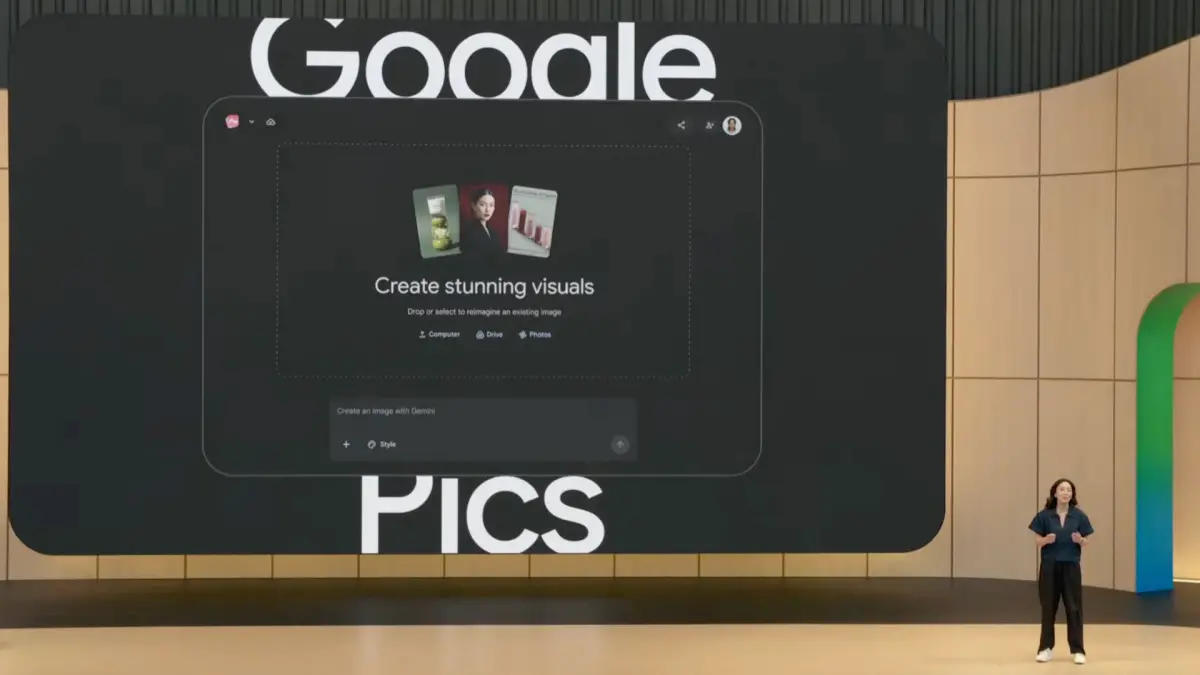
Google is making another aggressive move to consolidate its suite of productivity tools. At Google I/O 2026, the company unveiled Google Pics, a platform designed to handle everything from basic photo edits to full graphic design. The announcement positions Google Pics as a direct competitor to Canva, the widely popular online design tool that has become a staple for non-designers and professionals alike. With this new addition, Google aims to keep users within its Workspace ecosystem, reducing the need for third-party applications.
What is Google Pics?
Google Pics is an integrated tool within Google Workspace that allows users to edit existing photographs, generate new images from scratch using AI, and create visual graphics such as flyers, posters, and social media posts. The tool is built on Google's existing AI image generation platform, Nano Banana, which was previously introduced to developers. At the I/O keynote, Suz Chambers, Director of Google Creative Lab, demonstrated several features: cropping photos, removing unwanted objects, and adding text overlays to create professional-looking graphics. All these tasks are currently achievable in Canva, but Google is betting that deep integration with Workspace apps like Gmail, Docs, and Drive will give it an edge.
How Google Pics Works
The demo showed a user uploading a photo into Google Pics. With a simple selection tool, the user removed a distracting element in the background. Then, using AI-based inpainting, the tool filled the area with contextually appropriate content. Next, the user added a text box with a bold headline, chose a font and color scheme, and exported the resulting graphic directly to a Google Doc or Google Slides presentation. All actions were performed in real time, leveraging Google's cloud-based AI models. According to Chambers, the AI can also generate entirely new images based on natural language prompts, similar to tools like DALL-E or Midjourney, but tailored for business use cases.
Comparison with Canva
Canva, founded in 2013, has grown into a powerhouse with over 100 million monthly active users. It offers a freemium model with a vast library of templates, stock photos, and design elements. Canva's success lies in its simplicity and accessibility, allowing anyone to create polished designs without formal training. Google Pics appears to target the same audience, but with a focus on integration. Instead of switching between a browser tab for Canva and Google Workspace, users can edit images and design graphics directly within the Workspace interface. This seamless workflow could be a strong selling point for businesses already embedded in the Google ecosystem.
However, Canva's free tier is a significant advantage. Google Pics, at least initially, will only be available to subscribers of Google AI Pro and Google AI Ultra plans. These are premium tiers that add advanced AI capabilities to Workspace. Pricing details have not been fully disclosed, but Google AI Pro is expected to cost around $20 per user per month, while Google AI Ultra may be $30 or more. In contrast, Canva's free plan offers substantial functionality, and its Pro plan is $12.99 per month for individuals. Small businesses and solopreneurs may find Canva more affordable unless they already use Google Workspace at a higher tier.
The Role of AI in Google Pics
Artificial intelligence is central to Google Pics. The underlying Nano Banana platform uses a diffusion model trained on a vast dataset of images. This allows it to generate realistic visuals, as well as edit existing ones with high accuracy. During the demo, Chambers emphasized that the AI understands context. For example, removing a person from a beach photo does not just erase the person; it reconstructs the background sand, water, and sky in a natural way. The AI can also add elements based on prompts. A user can type a command like &8220;add a red balloon in the corner&8221; and the tool will generate it. This level of control blurs the line between photo editing and digital illustration, making Google Pics a versatile creative tool.
Privacy and Data Handling
Given Google&8217;s history with data privacy, questions arise about how user&8217;s images will be handled. Google has stated that images edited or created within Google Pics will not be used to train its AI models unless the user explicitly opts in. The company is also implementing content moderation filters to prevent the generation of harmful or inappropriate images. For Workspace enterprise customers, Google promises that data remains within their domain and is not accessible to other organizations. This may reassure businesses concerned about intellectual property leaks when using cloud-based AI tools.
Market Context and Industry Reaction
The announcement of Google Pics comes at a time when the graphic design market is increasingly competitive. Canva recently introduced AI features like Magic Eraser and text-to-image generation, blurring the lines between it and Google Pics. Adobe, with its Firefly generative AI, has also entered the space. Google&8217;s approach is unique because it embeds the tool directly into the productivity suite rather than offering it as a standalone application. Industry analysts note that this could simplify workflows for teams that already use Google Docs, Sheets, and Slides. However, some question whether Google can overcome Canva&8217;s brand loyalty and template ecosystem. Canva has amassed millions of templates across various categories, from resumes to Instagram stories. Google Pics will need to quickly build a comparable library or rely on AI-generated templates to compete.
Technical Limitations and Availability
Google Pics is currently in testing with a limited number of beta users. The full launch is planned for summer 2026, but only for Google AI Pro and Ultra subscribers. This means that users on the free tier of Google Workspace will not have access. It is unclear whether Google plans to introduce a free version later. The tool requires a stable internet connection because all processing is done on Google&8217;s servers. Offline editing is not supported at launch. For users with large files, the AI processing may take a few seconds, though Google claims that optimizations keep latency low.
Impact on Design Workflows
For organizations heavily invested in Google Workspace, Google Pics could streamline design workflows. A marketing team can create a social media graphic, edit it in Google Pics, and insert it directly into a shared Google Doc or presentation without leaving the browser. This reduces friction and the need for file downloads and uploads. Additionally, since Google Pics is integrated with Drive, all assets are automatically saved and version-controlled. Collaboration features allow multiple users to edit the same image simultaneously, similar to how Google Docs handles collaborative editing. This is a feature that Canva offers through its team functionality, but Google&8217;s real-time co-editing may be more seamless within its ecosystem.
Competing with Canva&8217;s Ecosystem
Canva has expanded beyond design into presentations, whiteboards, and even websites. Google&8217;s counter-strategy appears to be strengthening each Workspace app with embedded AI capabilities rather than creating a separate platform. Google Pics is not a standalone app; it is a tool accessible from within other Workspace apps. This could be both a strength and a weakness. On one hand, it reduces app switching. On the other hand, users accustomed to a dedicated design workspace like Canva may find Google Pics less feature-rich. For example, Canva offers thousands of professionally designed templates for every occasion. Google Pics may rely on users generating their own designs from scratch or using AI-suggested layouts. Whether that will be sufficient remains to be seen.
Historical Context: Google&8217;s Previous Design Tools
Google has attempted to compete in the design space before. In 2010, the company launched Google Images, a search engine for images, not to be confused with this new tool. It also acquired and later shut down several creative tools, such as Google+ Photos and Picnik, a photo editing service. More recently, Google introduced an AI art generator called ImageFX, which was available through the AI Test Kitchen. Google Pics represents a more serious and integrated effort. By tying it directly to Workspace, Google signals that design capabilities are now a core productivity feature, not an experimental add-on. If successful, it could shift how millions of workers create visual content daily.
User Sentiment and Early Reactions
Early reactions from the tech community have been mixed. Enthusiasts praise the potential for seamless integration but worry about pricing and the loss of Canva&8217;s user-friendly template marketplace. Some beta testers have reported that the AI editing tools are impressively accurate, especially for object removal and background changes. However, text overlay features are still basic compared to Canva&8217;s extensive typography options. Google has announced plans to add more advanced text formatting, including curved text and letter spacing adjustments, in future updates. The company also plans to collaborate with third-party template creators to expand its library, similar to Canva&8217;s Canva Creators program.
The Future of Google Pics
Looking ahead, Google Pics could evolve into a full design suite. The company already has a strong foundation with its AI models and cloud infrastructure. If Google decides to offer a free tier or bundle it with existing Workspace plans, it could quickly gain market share. The key will be execution: ensuring the tool is reliable, fast, and feature-rich enough to satisfy both casual users and professionals. For now, Google Pics is a promising entry into the graphic design market, but it faces an uphill battle against established players like Canva and Adobe. The summer 2026 launch will be the true test.
Source: Mashable News