

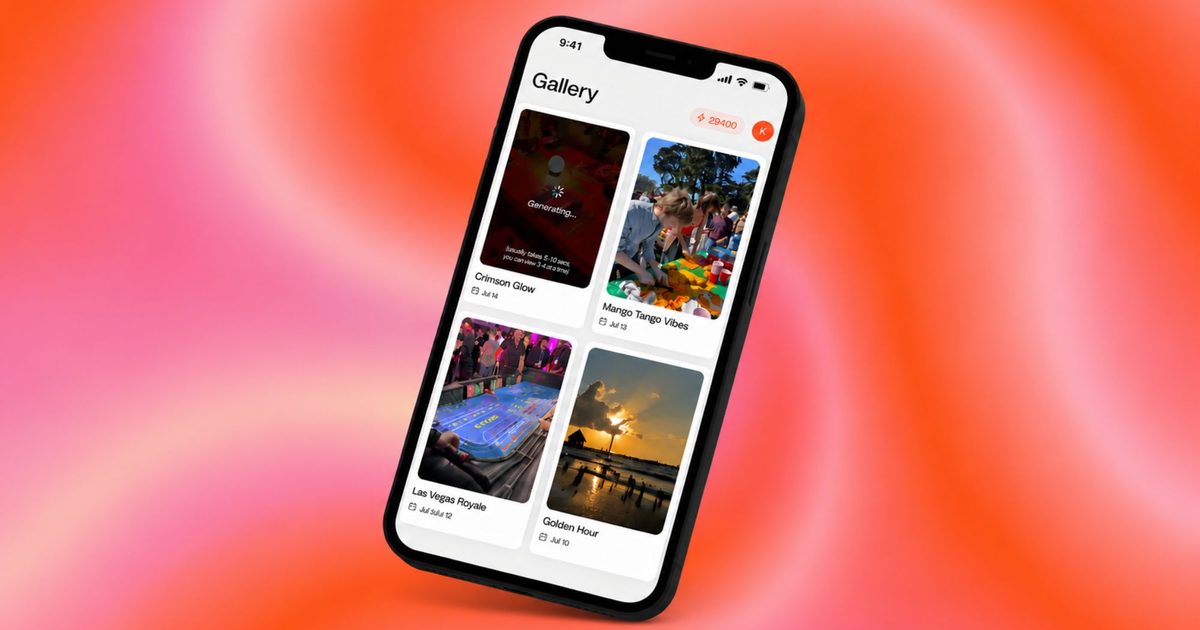
Your camera roll is probably packed with vacation photos, birthday videos, and random clips that never make it to Instagram or TikTok. If video editing has kept you from posting more on social media, a new app wants to take that job off your plate entirely.
Reelful is an iOS app that uses AI to automatically turn your existing photos and videos into polished, ready-to-post reels for TikTok and Instagram. It addresses a common pain point: many people capture moments but lack the time, skill, or patience to edit them into engaging social media content. With Reelful, the user does not need to edit, trim, or sync audio—the AI handles all those tasks.
How does Reelful turn your clips into polished social media videos?
You start by typing a prompt where you describe the story you want to tell, whether that is a travel recap, a product demo, or an event highlight. Next, you record a 30-second voice sample so the app can create a voice clone to narrate your video. This voice cloning technology uses a short audio sample to synthesize a natural-sounding narration that matches your tone and cadence. Then you simply select the photos and clips from your camera roll that you want included. Reelful takes over from there, planning the video, writing the script, adding your AI voiceover, and assembling the final cut complete with captions, music, and sound effects.
The app can even animate still photos into short video clips, so a picture of someone holding a beer could turn into a brief moving clip of that same person taking a sip. This feature uses keyframe animation and motion interpolation to bring static images to life, mimicking the effect of short clips. Once your video is ready, you can keep refining it by chatting with the app to swap the music, tweak the script, or adjust other details. This conversational editing interface is a significant departure from traditional timeline-based editors, making the process more intuitive for non-technical users.
What does Reelful cost?
Reelful offers one-time credit purchases or monthly subscriptions, depending on how often you create content. Credit bundles start at five videos for $15, 15 videos for $43, or 33 videos for $90. Regular creators can choose the Creator plan at $25 a month for 10 videos or the Pro plan at $50 a month for 25 videos. Heavy users can opt for the Studio plan, which includes 60 videos a month for $100. The app is currently only available on iOS, with Android and web versions expected down the line.
Pricing is competitive compared to other AI video tools. For example, popular alternatives like InVideo AI and Pictory offer similar auto-video generation but often require higher monthly fees or limit output quality. Reelful’s per-video cost for credit packs is about $3 per video (for the 5-video pack) or $2.87 per video for the 15-video pack, which is affordable for casual creators. The monthly plans bring the cost down to $2.50 per video for the Creator plan and $2 per video for the Pro plan, while the Studio plan drops to roughly $1.67 per video. This pricing strategy targets a wide range of users, from hobbyists to social media managers.
How Reelful fits into the broader AI video editing landscape
The rise of generative AI has transformed video creation. Tools like Runway ML, Synthesia, and CapCut’s AI features have already lowered the barrier to entry for video production. Reelful differentiates itself by focusing specifically on repurposing existing camera roll media—rather than generating entirely new visuals from text prompts. This is a key differentiator because many users have hundreds of unused photos and videos that could be turned into content. By automating the storyboarding, scripting, voiceover, and editing processes, Reelful effectively acts as a virtual video editor.
Voice cloning is another notable feature. While other tools offer text-to-speech, Reelful’s ability to clone a user’s voice from a 30-second sample adds a personal touch. This could be particularly useful for content creators who want to maintain a consistent vocal presence without recording separate narration for each video. However, voice cloning raises ethical and privacy considerations. The app must ensure that voice data is securely stored and not misused. Reelful has not publicly disclosed full details of its privacy policy regarding voice samples, but users should be cautious and review permissions.
The conversational editing interface is also innovative. Instead of struggling with complex timelines and keyframes, users can chat with the app to make changes. For instance, if a user wants to replace the background music with a trending track, they can simply type “Change music to something upbeat” and the AI adjusts accordingly. This natural language interaction reduces learning curves and makes video editing accessible to everyone, including those with no prior experience.
Potential limitations and challenges
Despite its promise, Reelfufaces several hurdles. First, the app is initially iOS-only, which limits its reach to a portion of the smartphone market. Android and web versions are planned but no release dates have been announced. Second, the quality of output depends heavily on the source material. Low-resolution or poorly lit photos and videos may not produce polished reels, even with AI enhancements. Third, voice cloning may sometimes sound robotic or unnatural if the sample is noisy or the user’s voice is not clear. The app’s reliance on AI also means occasional errors in captioning, timing, or music selection—though users can refine results through chat.
Another challenge is competition. Established platforms like Canva, Adobe Premiere Rush, and even TikTok’s built-in editing tools offer increasingly sophisticated AI features. To stand out, Reelful must maintain a high quality-to-price ratio and continuously improve its algorithms. Additionally, user adoption may be slow if people are reluctant to grant the app access to their camera roll and voice data.
Who should use Reelful?
Reelful is ideal for casual social media users who want to post more frequently without spending hours editing. Small business owners, influencers, and event photographers could also benefit from quick, automated reel creation. For example, a travel blogger could compile a trip highlight reel in minutes, or a restaurant owner could create a food video from photos of dishes. Students and non-profit organizations with limited budgets may also find the credit packs affordable. However, professional video editors or those requiring highly customized outputs may still prefer traditional editing software.
The app’s pricing and features make it particularly appealing for the “creator middle” — users who publish regularly but not at a volume justifying expensive tools. The Studio plan, at $100 per month for 60 videos, is cost-effective for agencies or teams managing multiple social media accounts.
Technical aspects and future roadmap
Reelful leverages several AI models: natural language processing for script writing, computer vision for scene detection, and text-to-speech synthesis for voiceover. The animation of still photos likely uses a technique called “warping” or “2D to 3D photo animation” similar to what apps like Motionleap offer. The app probably runs on cloud servers to handle complex processing, which means an internet connection is required.
Looking ahead, Android and web versions could significantly expand the user base. Web access would allow creators to use the tool on desktops, potentially integrating with cloud storage services like Google Photos or Dropbox. Future updates might include support for longer videos, multiple voice styles, or collaboration features. As AI models improve, the quality of voice cloning and script generation will likely become more natural, narrowing the gap between AI-generated and human-edited content.
In the coming months, Reelful could also partner with social media platforms for direct publishing, eliminating the need to download and upload videos separately. This integration would streamline the workflow even further, making it a one-stop solution for content creation.
For now, Reelful is a promising entry in the AI video editing space, offering a simple solution for a widespread problem. Whether it becomes a staple for casual creators or remains a niche tool will depend on its execution, privacy safeguards, and ability to evolve with user needs.
Source: Digital Trends News