

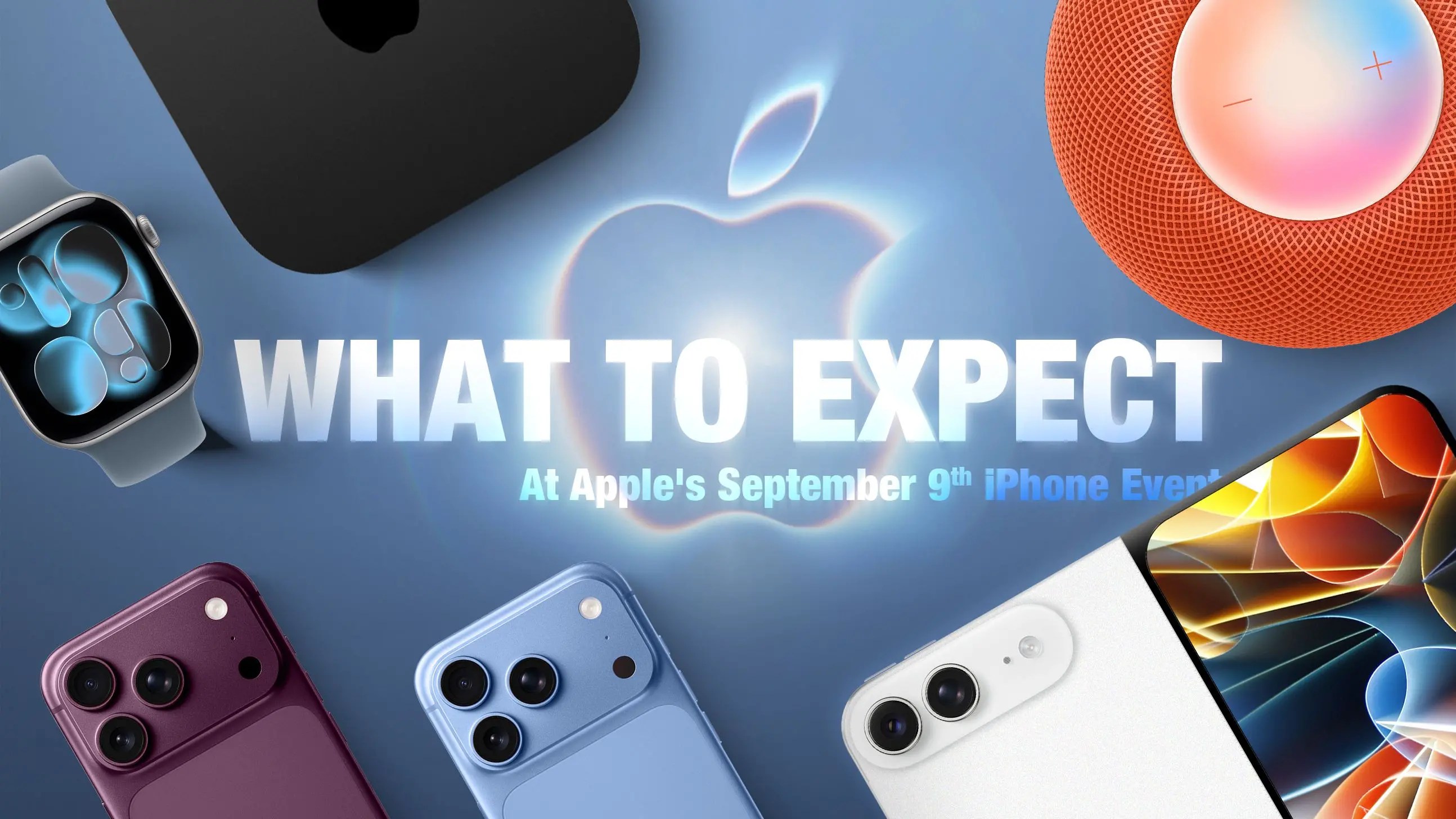
Apple has confirmed that its next major hardware event will be held on Wednesday, September 9, at 10:00 a.m. Pacific Time. The event features the tagline "Surprise and Shine," and it is expected to be one of the most substantial product reveals Apple has ever staged. Alongside the usual Pro and Pro Max iPhones, Apple is planning to introduce its first foldable device, a product line that could redefine the company's smartphone strategy for years to come. The September presentation is also likely to bring new Apple Watch models, updated AirPods, home-device announcements, and the first public release dates for Apple’s 2026 operating systems.
Foldable iPhone: A New Era for Apple
Apple's 2026 iPhone lineup will include its first foldable handset, widely referred to as the iPhone Ultra. The design is said to be a book-style foldable, meaning it opens vertically like a book rather than vertically like a clamshell. The outer display measures approximately 5.5 inches and serves as the primary screen when the device is closed. When opened, the inner OLED display expands to a tablet-like 7.8 inches, offering a canvas that is wider than it is tall. The device is often compared to an iPad mini that folds in half, and it may share a similar feel when unfolded.
Apple has long been rumored to be working on a folding iPhone, and the design team reportedly focused heavily on reducing the visible crease. A completely crease-free panel does not yet appear feasible, but Apple is said to have minimized the crease with an optically clear adhesive that fills microscopic cracks caused by repeated bending. The company is also believed to have engineered a durable liquid metal hinge, a component that had to withstand tens of thousands of open-and-close cycles. Foldable phones are generally more fragile than standard handsets, so durability was a priority for Apple's industrial design group.
When unfolded, the iPhone Ultra could be as thin as 4.5mm, which would make it the thinnest iPhone Apple has ever produced. When folded, it is expected to measure about 9mm, a little thicker than the 8.75mm iPhone 17 Pro Max due to the hinge and stacked displays. Such an aggressive thin design forced Apple to make compromises. According to multiple reports, there is no room for the TrueDepth camera system that powers Face ID. Instead, the iPhone Ultra is expected to include a Touch ID side button, similar to the approach used on the iPad Air and iPad mini. Both the inner and outer displays are still reported to have front-facing cameras for video calls and selfies, but biometric authentication will rely on Touch ID.
The rear camera system is also affected by internal space constraints. Unlike the premium Pro iPhones with their triple-lens camera arrays, the iPhone Ultra is rumored to have only two rear lenses. It may include an Ultra Wide lens and a Wide lens but no telephoto lens. This design would work whether the device is folded or unfolded, since the rear camera module sits on a portion of the back that remains exposed in both configurations. While some early dummy models appeared to lack the magnetic ring needed for MagSafe, later reporting from Bloomberg confirmed that MagSafe charging will still be included.
Performance-wise, the iPhone Ultra will almost certainly use Apple’s latest A20 Pro chip, built on a 2nm process. Rumors suggest this chip could be about 18 percent faster than the A19 Pro and up to 30 percent more power efficient. The A20 Pro is also believed to have a seven-core GPU, a wider memory interface, and a large L2 cache for efficiency cores. Paired with the chip, the device is expected to ship with 12GB of RAM, which could be a first for an iPhone.
Apple has also been working on its own cellular modem for years, and the 2026 iPhones could be among the first to use the company’s C2 modem. The C2 is expected to be faster and more efficient than Apple's earlier C1X chip. However, it is not yet clear whether the C2 supports mmWave 5G, the high-band frequency used primarily in the United States. If the C2 lacks mmWave, Apple may either use Qualcomm modems for units sold in America or limit the foldable iPhone to sub-6GHz 5G speeds around the world. That decision could have major implications for network performance and for Apple's long path toward complete modem independence.
Battery life should be a strength. The foldable iPhone is reportedly using two separate battery packs, one on each half of the device, for a combined capacity of between 5,400 mAh and 5,800 mAh. That would be noticeably larger than the 5,088 mAh battery in the iPhone 17 Pro Max, although the larger foldable display will also consume more power. Color options are expected to be conservative, with a silver or white finish and a deep indigo shade that is close to black. Pricing is expected to start at $2,000 and could reach $2,500 or more for higher-capacity models.
Software will play a crucial role in whether the foldable iPhone succeeds. Apple has reportedly advised developers to design apps that adapt to multiple screen sizes and aspect ratios so that both the closed and open states feel native. The iPhone Ultra is also expected to support multitasking, side-by-side apps, and sidebars, similar to the ways iPads handle productivity. If Apple can deliver a polished software experience, the device could become a compelling alternative to dedicated tablets for many users.
iPhone 18 Pro and iPhone 18 Pro Max: Refinements Rather Than Redesign
Alongside the foldable iPhone, Apple is expected to release the iPhone 18 Pro and iPhone 18 Pro Max. These models are believed to share a close visual similarity with the iPhone 17 Pro series. The dimensions may stay roughly the same, and existing cases could remain compatible. However, the camera plateau could be slightly thicker to accommodate a new variable aperture lens. The Pro Max model might also be a bit thicker and heavier than its predecessor because of a larger battery, though the increase may be modest.
Apple is expected to offer new colors for this generation, including dark cherry, light blue, and silver. Some rumors suggest the black iPhone 18 Pro option may be dropped. The overall appearance is predicted to remain largely unchanged, but a smaller Dynamic Island could arrive after early attempts to put Face ID under the display were abandoned. The 2026 Pro iPhones may instead use a more efficient LTPO+ display panel, which could improve battery life even before accounting for other hardware changes.
The camera system is likely to be the headline feature on the iPhone 18 Pro. Apple is expected to add a DSLR-like variable aperture to the main camera, giving users more control over the amount of light reaching the sensor. In bright outdoor scenes, a smaller aperture would reduce overexposure; in dark environments, a wider aperture would let in more light and help minimize noise. A variable aperture also offers creative control over depth of field. Some reports have said the variable aperture might be exclusive to the iPhone 18 Pro Max, but that has not been established conclusively. The camera system could also include a three-layer stacked sensor made by Samsung, which would improve readout speed and low-light performance, alongside a telephoto lens with a wider aperture. The Ultra Wide lens and front-facing camera may not receive significant upgrades. The Camera Control button, introduced in recent iPhone generations, may become simpler by dropping its capacitive swipe layer, leaving only a physical button for clicks.
As with the foldable iPhone, some or all iPhone 18 Pro models could use Apple's C2 modem, depending on whether Apple chooses to support mmWave with its in-house chip. The starting price for the iPhone 18 Pro is expected to rise, with estimates ranging from $100 to $300 above current prices. Apple is reportedly paying more for memory and storage, as seen in recent Mac and iPad price increases.
Apple Watch Series 12 and Apple Watch Ultra 4
The Apple Watch product line will also see updates. The Apple Watch Series 12 is not expected to feature a major redesign, but Apple may bring back a ceramic case option, which would offer both style and durability. Inside, a new processor could improve health and fitness tracking capabilities. In particular, Apple has been testing a continuous heart rate sensor mode that would collect data throughout the day. That data could feed a new Health app feature offering wellness scores and biometric trends similar to what Oura Ring owners see. The Apple Watch Ultra 4 is also expected to receive the same upgraded processor and related changes, without any major external redesign.
AirPods 5: A Likely Audio Upgrade
After multiple years of gradual updates, Apple is expected to bring the next brand of AirPods to the September stage. References to AirPods 5 have been found in early versions of Apple's operating systems, and the new earbuds could launch with the iPhone 18 lineup. Rumored features include an updated H3 chip for better sound quality and lower latency, along with the usual version split between models with active noise cancellation and models without it. Battery life improvements and a refreshed charging case are also possible.
Possible Surprises at the Event
Apple may have more in store beyond the core iPhone and wearable lineup. A long-rumored Home hub, featuring a 7-inch square display, an integrated camera, and presence detection sensors, could finally be announced. The hub would not only control smart home devices but also run apps, support video calls, and interact with Siri AI, the upgraded version of Siri expected in iOS 27. Apple has reportedly delayed its launch because Siri AI is a central feature, and the company wants the software to be ready before launching the hardware.
An updated Apple TV 4K is also possible, despite its less frequent release cycle. A new model could include a faster processor to support Siri AI and new gaming features. There have also been signs of a redesigned remote in Apple's code. The HomePod mini, already several years old, is due for a refresh and might see an upgraded processor and new color options. None of these devices have been confirmed for the September date, but Apple sometimes uses an iPhone event to focus attention on its broader ecosystem.
Software Release Dates and New CEO
Apple will likely use the event to announce public release dates for iOS 27, iPadOS 27, macOS Golden Gate, tvOS 27, watchOS 27, and visionOS 27. Release candidate versions of each operating system may be seeded to developers and public beta testers immediately after the event. Based on previous launch timelines, iOS 27 and its sister updates could become available as early as September 14, just days after the event.
The event will also mark a milestone for Apple's executive leadership. New Apple CEO John Ternus, who previously served as senior vice president of Hardware Engineering, will host his first iPhone event since taking over from Tim Cook. Cook, who was CEO for 15 years, has transitioned to the role of executive chairman and may not appear on stage at all. This leadership change means the tone and style of the presentation could feel different from the events of the past decade, even if Apple’s product roadmap remains unchanged.
Which Products Are Not Expected
Several products that were previously rumored for late 2026 are not likely to appear at the September event. The standard iPhone 18, for example, is expected to be delayed until the spring of 2027. This fall, Apple is reportedly only launching the iPhone 18 Pro, iPhone 18 Pro Max, and the foldable iPhone as part of its premium iPhone lineup. The lower-cost iPhone 18e and iPhone Air 2 are expected alongside the standard model in the spring. An Apple Watch SE 4 is also not expected this year. The M6 MacBook Pro, M6 iMac, OLED MacBook Pro, and OLED iPad mini are all either expected later this year or in early 2027, and they are unlikely to appear during an iPhone presentation.
Preorder Timing and How to Watch
Apple traditionally opens iPhone preorders on the Friday immediately following its event. That Friday this year falls on September 11, a date Apple has avoided for preorder launches since 2015. As happened in 2015, the preorder window could shift to Saturday, September 12. Apple's practice in recent years has been to begin preorders at 5:00 a.m. Pacific Time on the selected day. The new iPhones are expected to launch on Friday, September 18, regardless of the preorder date.
Apple's "Surprise and Shine" event is scheduled to be livestreamed at apple.com, on YouTube, and through the Apple TV app on supported devices. The stream will begin at 10:00 a.m. Pacific Time on Wednesday, September 9. Given the number of expected product announcements, this is likely to be one of the most closely watched Apple events in years.
Source: MacRumors News