

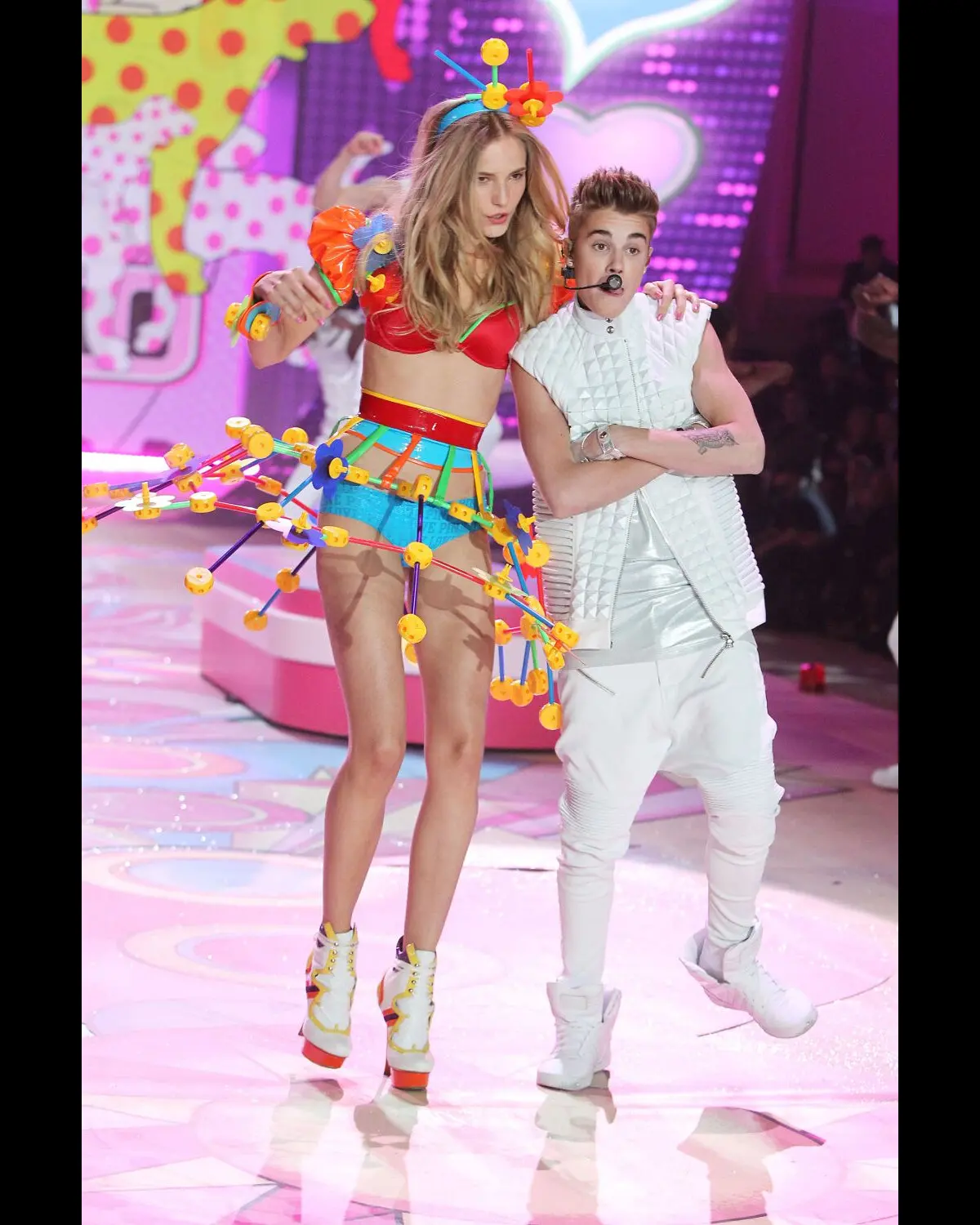
On November 7, 2012, the 69th Regiment Armory in New York City played host to one of the most glittering events on the fashion calendar: the Victoria's Secret Fashion Show. Among the usual parade of supermodels in elaborate wings and lingerie, an unexpected guest stole the spotlight for a brief, unforgettable moment. Justin Bieber, then at the height of his teen-pop fame, appeared on the runway alongside Swedish model Dorothea Barth Jorgensen. The photo of the pair posing together quickly became an iconic image of that year's show, capturing the intersection of pop music and high fashion.
The Setting: Victoria's Secret Fashion Show 2012
The Victoria's Secret Fashion Show has long been known for its theatrical productions, featuring elaborate sets, musical performances, and celebrity appearances. The 2012 edition was no exception. Held at the historic 69th Regiment Armory, the show was broadcast on CBS later that month. The event featured performances by Rihanna, Justin Bieber, and Bruno Mars, making it a star-studded affair. Bieber's role, however, went beyond singing; he was also featured as a special guest on the runway, posing with models during the 'Calendar Girls' segment. This segment paid homage to the brand's iconic swimsuit calendar, with models representing different months. Bieber made a brief appearance, walking alongside Dorothea Barth Jorgensen, who was one of the 12 'Calendar Girls' selected for the segment.
Who Is Dorothea Barth Jorgensen?
Dorothea Barth Jorgensen is a Swedish fashion model born on December 31, 1988, in Stockholm. She began her modeling career at a young age, signing with prestigious agencies like IMG Models. Over the years, she has walked the runways for top designers such as Versace, Chanel, and Dolce & Gabbana. Her appearance in the Victoria's Secret Fashion Show in 2012 was a career highlight, as the show was a platform that could catapult models to mainstream fame. Jorgensen's striking blonde hair and blue eyes fit the brand’s aesthetic perfectly, and her walk alongside Bieber added a pop-culture moment to her portfolio. After 2012, she continued to work in the fashion industry, appearing in campaigns for brands like H&M and lingerie lines, but she remains best known to casual audiences for that single runway walk with Bieber.
Justin Bieber's Career Trajectory in 2012
In 2012, Justin Bieber was already a global phenomenon. Having risen to fame in 2009 with his debut EP My World, he had released his second studio album Believe earlier that June. The album debuted at number one on the Billboard 200 and spawned hits like Boyfriend and As Long as You Love Me. Bieber was transitioning from a teen heartthrob to a more mature pop artist, and his appearance at the Victoria's Secret show was part of a broader strategy to cement his status as a crossover star. His performance at the show included a medley of As Long as You Love Me and Beauty and a Beat, the latter featuring Nicki Minaj. The runway moment, however, was a separate publicity stunt that generated thousands of headlines and social media posts. At the time, Bieber's relationship with Selena Gomez was also highly publicized, adding to the intrigue surrounding any interaction he had with other female celebrities. However, his pose with Jorgensen was purely professional, orchestrated by the show's producers to create viral content.
The Significance of Celebrity Cameos in Fashion Shows
Victoria's Secret pioneered the concept of integrating musicians into their runway shows long before other brands caught on. By the early 2010s, having a pop star walk the runway or perform live was a key part of the show's marketing strategy. These cameos blurred the lines between fashion and entertainment, attracting a broader audience that might not typically watch a lingerie show. Bieber's appearance was particularly effective because it leveraged his massive young fan base, who were eager to see him in any context. The photo of Bieber and Jorgensen was shared millions of times on Twitter and Facebook, giving Victoria's Secret free advertising. In retrospect, this moment exemplified the power of influencer marketing before the term became ubiquitous. Brands today continue to rely on celebrity appearances to generate buzz, but Victoria's Secret's approach in 2012 set a benchmark for integrating talent seamlessly into the show's narrative.
The Model's Perspective: Dorothea Barth Jorgensen on the Runway
For Dorothea Barth Jorgensen, walking alongside Justin Bieber was a surreal experience. In interviews years later, she recalled the energy backstage at the Armory. “It was absolute chaos,” she said in a 2015 interview with Vogue Scandinavia. “There are dozens of models, hair and makeup artists, and then the celebrities come in. I had no idea Justin was going to walk with me until the dress rehearsal. We had to practice the walk together twice, and he was so professional. He asked me how to pose for the cameras, and I told him to just look confident and maybe wink.” The result was a playful moment that captured Bieber's signature charm. Jorgensen also noted that the Victoria's Secret show was one of the most demanding jobs in modeling, requiring intense physical preparation and stamina. Models often walk for hours in heavy wings and high heels, and the addition of a celebrity partner added pressure but also excitement. For Jorgensen, the experience boosted her profile significantly, leading to more bookings in the United States and Asia.
The Legacy of the 2012 Victoria's Secret Show
The 2012 Victoria's Secret Fashion Show is remembered not only for Bieber's cameo but also for its ambitious themes. The show featured segments like 'Cirque du Soleil' (with acrobats), 'Silver Screen Angels' (inspired by old Hollywood), and 'Angels in Bloom' (with floral motifs). The 'Calendar Girls' segment, where Bieber appeared, featured distinctive vintage-inspired calendar artwork that was projected behind the models. The show also marked the debut of new 'Angels' like Karlie Kloss and the return of veterans like Adriana Lima and Alessandra Ambrosio. Critics praised the show's production values but also noted a growing tension between the brand's image and evolving social norms around body positivity. In subsequent years, Victoria's Secret faced backlash for its lack of diversity and unrealistic beauty standards, leading to a drastic rebranding in the 2020s. The 2012 show, however, remains a nostalgic touchstone for many fans of the era, encapsulating a moment when the brand was at its cultural peak.
Justin Bieber's Later Interactions with Fashion
After his 2012 runway appearance, Justin Bieber continued to engage with the fashion world, albeit in different ways. He launched his own clothing line, 'Drew House', in 2019, which embraced a more laid-back, skate-inspired aesthetic. He also became a muse for high-end designers like Virgil Abloh (off-White) and often attended fashion weeks. However, his 2012 Victoria's Secret moment remains one of the few times he actually walked a runway. In retrospect, that appearance presaged the modern trend of celebrities becoming brand ambassadors for luxury houses. For example, Bieber later collaborated with brands like Balenciaga and Fear of God. Yet, for fans of early 2010s pop culture, the image of Bieber in a leather jacket, sneakers, and jeans walking alongside a supermodel in lingerie is an indelible snapshot of that era's hybrid of music and fashion.
The Venue: 69th Regiment Armory
The 69th Regiment Armory, located at 68 Lexington Avenue in Manhattan, is a historic building that has hosted many significant events. Built in 1906, it was originally used for military training and later became a venue for art shows, including the famous 1913 Armory Show that introduced modern art to America. In the 21st century, it has been used for fashion shows, film shoots, and private parties. The Victoria's Secret Fashion Show chose the Armory for its vast, column-free interior space that could accommodate a massive runway, lighting rigs, and seating for thousands of guests. The building's classical architecture provided a striking contrast to the modern, glitzy spectacle of the show. For the 2012 event, the Armory was transformed into a fantasy wonderland, with elaborate sets that changed between segments. The Bieber-Jorgensen moment was captured against a backdrop of oversized calendar pages, emphasizing the 'Calendar Girls' theme. The Armory's historic walls witnessed one of the most viral moments of the decade, a testament to how fashion shows can create cultural touchpoints that transcend the industry.
Broader Impact on Celebrity Modeling Appearances
The success of Justin Bieber's runway walk encouraged other brands to enlist musicians and actors for similar cameos. In the years that followed, we saw Beyoncé at the Givenchy show, Rihanna at H&M, and even Kanye West at various fashion shows. Victoria's Secret itself continued the tradition, having Taylor Swift walk in 2013, Ed Sheeran in 2014, and Lady Gaga in 2016. These appearances became a staple of the show's marketing, often generating more buzz than the actual models. However, the Bieber-Jorgensen moment was unique because it was one of the first times a male pop star walked the runway with a model in a lingerie show. It broke the gender barrier, showing that men could be part of the Victoria's Secret narrative without being performative. The photo also spawned countless memes and parodies, indicating how deeply it entered the public consciousness. For Jorgensen, the image became her most recognizable work, and for Bieber, it was a fun detour that showcased his versatility as an entertainer.
Conclusion of the Article (No Conclusion Section)
The photograph of Justin Bieber and Dorothea Barth Jorgensen on the Victoria's Secret runway remains a fascinating artifact of early 2010s pop culture. It captures a moment when a teen idol mingled with the fashion elite, creating an image that was both aspirational and accessible. While the fashion industry has evolved since then, and Victoria's Secret has undergone significant changes, that single pose continues to be a talking point for fans and historians alike. The 69th Regiment Armory, now a landmark, once again served as a backdrop for a cultural fusion that defined an era. For those who were there or who saw the images later, it is a reminder of the power of a well-orchestrated fashion show to create moments that endure far beyond the clothes.
Source: Purepeople News