

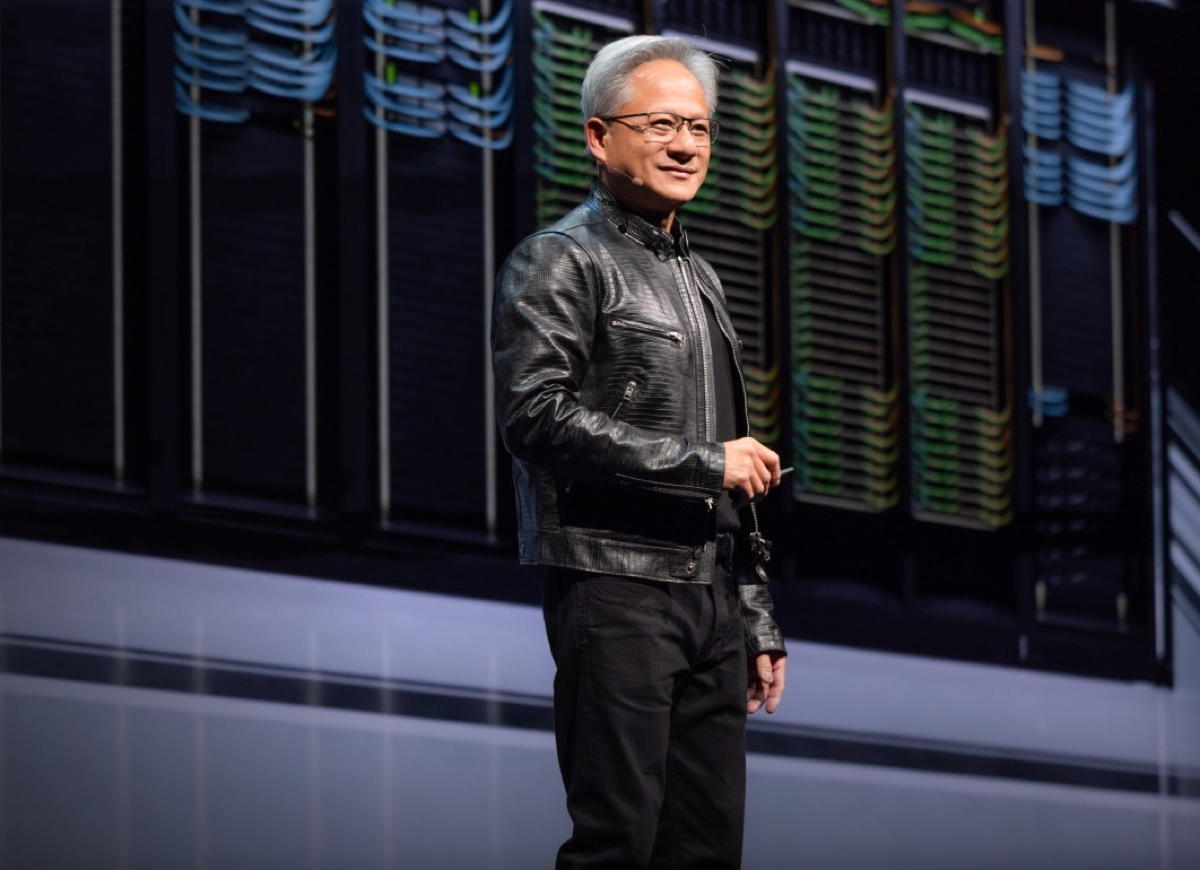
Nvidia chief executive Jensen Huang announced that the company will "probably" not invest $100 billion in OpenAI, following a significantly smaller $30 billion contribution as part of a funding round last week. The reason, Huang explained, stems from OpenAI's likely initial public offering (IPO) sometime this year. This marks a notable shift from earlier speculation about a deepening financial relationship between the two leading firms in the generative artificial intelligence space.
"I think the opportunity to invest $100 billion in OpenAI is probably not in the cards," Huang said during a Morgan Stanley conference. He further noted that because of the expected IPO, "this might be the last time we'll have the opportunity to invest in a consequential company like this." The statement underscores a broader trend in which major tech players are reassessing their investment strategies amid rapid changes in the AI landscape.
Background on Nvidia and Jensen Huang
Nvidia, founded in 1993 by Jensen Huang, Chris Malachowsky, and Curtis Priem, has evolved from a graphics processing unit (GPU) manufacturer into a powerhouse in artificial intelligence computing. Under Huang's leadership, the company's chips became the backbone of AI training and inference, powering everything from autonomous vehicles to chatbots. Huang, who holds a B.S. in electrical engineering from Oregon State University and an M.S. from Stanford University, has been the president and CEO since the company's inception. His vision for accelerated computing has driven Nvidia's market capitalization to over $1 trillion, making it one of the most valuable companies globally. The firm's CUDA parallel computing platform and recent GPU architectures like Hopper and Blackwell have solidified its dominance in AI hardware.
Nvidia's relationship with OpenAI dates back to the early days of the AI startup. OpenAI, founded in 2015 by Elon Musk, Sam Altman, Greg Brockman, Ilya Sutskever, and others, initially operated as a nonprofit research lab before transitioning to a "capped-profit" model. Its breakthroughs, including the GPT series of large language models and the multimodal GPT-4, relied heavily on Nvidia's GPUs for training. This dependency fostered a symbiotic yet cautious financial bond. Reports of a potential massive investment surfaced in September 2023, when Nvidia disclosed plans to invest up to $100 billion in OpenAI over several years, tied to the startup's deployment of Nvidia chips in data centers. However, that agreement was never finalized, and by January 2024, talks had stalled.
The OpenAI Investment Speculation
The recent comment by Huang explicitly ending hopes of a $100 billion injection brings clarity to months of speculation. The $30 billion investment that did materialize is still substantial but pales in comparison to earlier figures. Industry analysts suggest that OpenAI's IPO timeline has reshaped Nvidia's calculus. An IPO would recategorize OpenAI from a private startup to a publicly traded company, altering valuation dynamics and diluting strategic advantages for early investors like Nvidia. Moreover, regulatory scrutiny of large AI investments has intensified globally. In the United States, the Federal Trade Commission and the Department of Justice have examined Nvidia's market power and potential anticompetitive practices. In Europe, the AI Act and data protection regulations add layers of compliance.
Huang's remarks also reflect a maturation of the AI industry. The initial euphoria around generative AI, sparked by the launch of OpenAI's ChatGPT in late 2022, has given way to a more sober assessment of costs and infrastructure needs. Building and operating massive data centers for AI workloads requires enormous capital expenditure. A single large language model training run can cost tens of millions of dollars in compute resources. Data centers consume vast amounts of electricity—a single facility can use as much power as several thousand homes—and require significant water for cooling. This has sparked pushback from local communities and environmental groups.
The Anthropic Investment
Huang also addressed Nvidia's $10 billion investment in Anthropic, another prominent AI startup known for its Claude family of models. He characterized this as probably the last opportunity to invest in Anthropic due to its expected IPO. Anthropic was founded in 2021 by former OpenAI employees including Dario Amodei and Daniela Amodei, who left over disagreements about safety and governance. The company emphasizes constitutional AI and responsible development. Its funding rounds have included significant backing from Google, Spark Capital, and now Nvidia. The $10 billion commitment underscores Nvidia's strategy of spreading its investments across multiple AI players to hedge against over-reliance on any single company. However, the IPO prospects for both OpenAI and Anthropic signal a shift toward public markets, which could reduce opportunities for large private strategic investments.
Changing Economics of the AI Boom
The broader context of Huang's statements is the changing economics of the AI boom. Last year, optimistic announcements about massive investments dominated headlines. Venture capital flowed heavily into AI startups, and semiconductor stocks soared. However, realities have set in. Building data centers for AI is not only capital-intensive but also resource-intensive. A typical hyperscale data center requires 100–150 megawatts of power, with some planned facilities reaching 1 gigawatt. This strains local grids and can lead to higher energy prices for residents. Water usage for cooling, especially in drought-prone regions, has become a contentious issue. In places like Virginia's "Data Center Alley" and Arizona's Silicon Desert, community resistance has delayed or blocked new projects.
Additionally, the supply chain for advanced chips remains tight. Nvidia's GPUs, particularly the H100 and upcoming B100, are in high demand with lead times extending months. The U.S. government's export restrictions on high-performance chips to China have also reshaped the market. Companies like OpenAI and Anthropic must navigate these geopolitical constraints while scaling their models. The cost of inference (running models after training) is also rising as AI applications become more widespread. Energy prices and regulatory compliance add further pressure.
Despite these challenges, the AI industry continues to grow rapidly. Enterprise adoption of AI solutions is accelerating, with applications in healthcare, finance, education, and manufacturing. Nvidia's data center revenue has soared, reaching $18.4 billion in the fourth quarter of fiscal 2024, a 409% year-over-year increase. The company's product roadmap includes new platforms for autonomous driving, robotics, and digital twins. Huang sees AI as the "fourth industrial revolution" and has positioned Nvidia as the foundational infrastructure provider.
The environmental backlash, however, is mounting. Data centers now account for about 1-2% of global electricity consumption, a figure expected to rise sharply. Activists and some policymakers have called for greater transparency and sustainability measures. In response, companies like Nvidia have introduced more energy-efficient chips and advocated for renewable energy sourcing. But the sheer scale of demand means that even efficiency gains may not offset absolute growth in energy use.
Looking ahead, the relationship between Nvidia and its AI startup partners will likely evolve. As OpenAI and Anthropic move toward IPOs, their dependence on Nvidia may become more transactional. Nvidia, in turn, might focus on investing in earlier-stage startups or vertical applications that are less likely to go public soon. Huang's comments suggest a pragmatic approach: capitalizing on the current wave without overcommitting. The $100 billion figure, while never realized, highlights the extraordinary financial forces at play in the AI sector. For now, the industry must balance ambition with the harsh realities of infrastructure, regulation, and public opinion.
Source: Silicon UK News