

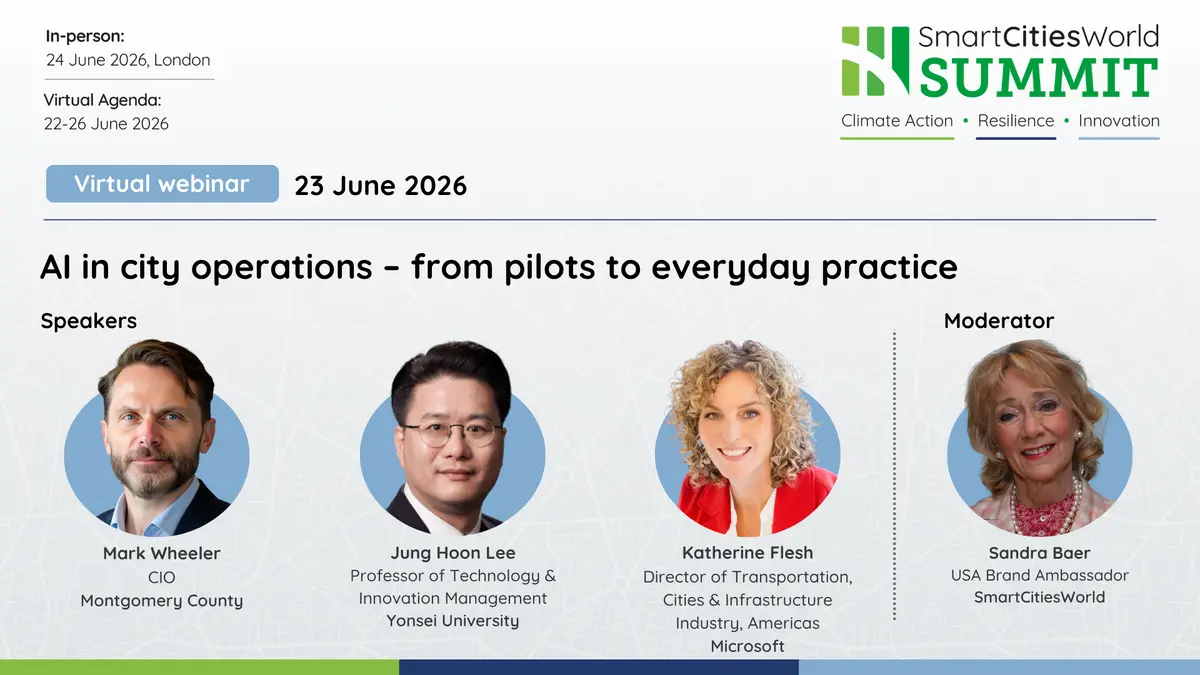
Key facts
- The panel discussion examines how connected data and artificial intelligence can improve citizen engagement, break down departmental silos and support faster, better-informed decisions.
- AI, edge computing and computer vision are presented as tools for turning growing volumes of urban data into smarter, faster decisions and more responsive services.
- Cities face combined pressures from climate change, infrastructure resilience and digital transformation.
- A 2026 smart cities summit during London Climate Action Week will bring urban leaders and partners together to explore how these agendas intersect and how strategy can become practical action.
- Malaysia is highlighted for AI-powered urban innovation at the first Southeast Asian smart city expo in Kuala Lumpur.
- Singapore and Sunderland are cited as examples of cities building smart city reputations through digital infrastructure, low-carbon innovation and resilience.
- An in-depth conversation with an urban AI expert explores how AI is moving from pilots to real-world impact, the emerging AI super gap between cities, and why data platforms, AI-ready infrastructure and effective governance matter.
- Smart sensor networks can improve indoor safety by detecting risks early, improving situational awareness and supporting healthier, more secure and sustainable buildings.
- Industry leaders explain how urban AI applications are evolving, with projects already delivering significant impact.
- Related panel discussions cover the energy transition and unlocking value in cities from buildings, data and AI.
From pilots to everyday practice
The panel discussion focuses on a practical question that now shapes urban technology programs: how can cities move artificial intelligence from isolated experiments into routine operations? The starting point is connected data. When information from transport, utilities, buildings, public spaces and citizen services is integrated responsibly, cities can make faster and better-informed decisions. That shift matters because many urban AI projects have proved that the technology can work in controlled settings. The harder task is to make it work every day, across departments, under procurement rules and within public budgets.
The discussion places AI alongside edge computing and computer vision as part of a broader operating model for cities. Edge computing allows data to be processed closer to where it is generated, reducing latency and bandwidth demands. Computer vision can interpret images and video from streets, stations, buildings and public spaces. Used together, these tools can help cities detect problems earlier, allocate staff more effectively and respond to changing conditions with greater precision. The panel's emphasis is not on novelty but on repeatability. A pilot becomes everyday practice only when it has clear ownership, reliable data, maintainable infrastructure and a measurable public benefit.
Connected data breaks down silos
Departmental silos remain one of the biggest barriers to operational AI. A transport team may hold mobility data, a waste team may track collection routes, a housing team may manage building systems and a public safety team may monitor incidents. Each dataset can be valuable on its own, but the greater value emerges when they are connected through common standards and governance. The panel discussion explores how connected data can improve citizen engagement and break down boundaries between services. For residents, the result should be more joined-up responses: a missed bin collection, a blocked road, a faulty streetlight or an unsafe building should not require the resident to understand the internal structure of local government.
Breaking down silos is also an organizational challenge. Data sharing requires legal agreements, privacy safeguards, common definitions and trusted leadership. It requires departments to agree on what a shared data platform is for and who is accountable when automated systems inform decisions. The panel discussion highlights that AI does not remove the need for governance; it raises the stakes. Cities need clear rules for data quality, access, retention and security. They also need mechanisms for human review when automated tools affect residents. The move from pilots to practice therefore depends as much on institutional design as on algorithms.
Edge computing and computer vision in the field
Edge computing and computer vision are already being applied to urban problems that require fast, local interpretation of data. The panel discussion considers how these technologies can help cities turn growing volumes of urban data into smarter, faster decisions and more responsive services. Rather than sending every data stream to a central cloud, edge devices can filter, analyze and act on information locally. This can be useful for traffic management, public space monitoring, infrastructure inspection and environmental sensing.
- Traffic and mobility: computer vision can help detect congestion, incidents and changes in road use, while edge processing can support quicker signal adjustments and alerts.
- Public safety and situational awareness: sensor networks and video analytics can help identify risks, but they must be paired with strict privacy controls and clear public accountability.
- Infrastructure maintenance: image recognition can help spot defects in roads, bridges and public facilities, allowing repair teams to prioritize work.
- Environmental monitoring: connected sensors can track air quality, noise and other conditions, giving cities more granular evidence for policy and operations.
- Waste and cleanliness: cameras and sensors can help identify overflowing bins or illegal dumping, improving service routes and response times.
The panel discussion also stresses that computer vision is not a substitute for judgment. Cities must decide what should be automated, what should be flagged for human review and what should not be monitored at all. Public trust depends on transparency about purpose, data retention and redress. The operational benefit of edge computing can be undermined if cities fail to explain why data is being collected and how it will be used.
Citizen engagement and responsive services
AI in city operations is often discussed in terms of efficiency, but the panel discussion places citizen engagement at the center. Connected data and AI can help cities understand demand patterns, communicate more clearly and tailor services to different needs. For example, a city might use data to identify neighborhoods that are repeatedly reporting the same issue, or to predict where additional support is needed during extreme weather. These insights can help officials move from reactive service delivery to more proactive planning.
Responsive services also require accessible channels. Residents need ways to report problems, ask questions and receive updates that fit their daily lives. AI can support multilingual communication, triage requests and route cases to the right team, but it should not create new barriers. The panel discussion points to the importance of designing services around user needs rather than departmental structures. A joined-up city service is one where data flows behind the scenes while the resident experiences a single, coherent interaction. That is a significant organizational and technical achievement, and it is one of the clearest measures of whether AI has moved from pilot to practice.
Climate resilience and digital transformation
The panel discussion takes place as cities confront the combined pressures of climate change, infrastructure resilience and digital transformation. These agendas intersect. Flood risk, heat stress, air quality and energy demand all require better data and faster decisions. Digital infrastructure can support early warning, resource allocation and long-term planning, but it must itself be resilient. A city cannot rely on AI for emergency response if the sensors, networks and power systems that feed it fail during a crisis.
A 2026 smart cities summit during London Climate Action Week will bring urban leaders and partners together to explore how these agendas intersect and how cities can translate strategy into practical action. The panel discussion contributes to that effort by focusing on operations rather than aspiration. The question is not whether AI is interesting, but whether it improves a service, reduces risk or helps a city meet climate and resilience goals. That requires metrics that go beyond pilot success. Cities need to track service reliability, response times, energy use, equity of access and public trust. Without such measures, it is difficult to know whether an AI project is genuinely improving everyday practice.
Global examples point to different routes
The discussion draws on international examples that show how cities are approaching smart city development in different ways. Malaysia is highlighted for AI-powered urban innovation at the first Southeast Asian smart city expo in Kuala Lumpur. The event signals growing regional ambition and a desire to connect urban leaders, technology providers and researchers around practical solutions. For cities in fast-growing regions, the opportunity is to design data and AI systems alongside new infrastructure rather than retrofitting them later.
Singapore is cited as an example of a city-state that continues to build its reputation as one of the smartest nations in the world. Its approach has long combined digital government, urban planning and technology investment. Sunderland is highlighted as a city repositioning itself through digital infrastructure and low-carbon innovation, with the aim of building a resilient, future-focused economy. These examples are not identical, and that is part of the point. Cities start from different legacies, resources and political contexts. The panel discussion uses these cases to show that the path from pilot to practice is shaped by local conditions, not by a single model.
The AI super gap and the governance test
An in-depth conversation with an urban AI expert explores how AI is moving from pilots to real-world impact in cities worldwide. The discussion considers the latest global smart city rankings, the emerging AI super gap between cities, and why the next phase of urban innovation depends on data platforms, AI-ready infrastructure and effective governance. The idea of an AI super gap points to a widening divide between cities that can build and operate advanced data systems and those that cannot. The gap is not only about funding. It is also about skills, procurement capacity, data standards, cybersecurity and the ability to coordinate across departments.
Governance is the test that determines whether AI strengthens or weakens public institutions. Cities need to know who is accountable for automated decisions, how residents can challenge errors and how sensitive data is protected. They need procurement rules that avoid lock-in and support interoperability. They need technical teams that can maintain systems after a pilot ends. The panel discussion suggests that the most successful cities will be those that treat AI as part of public infrastructure rather than as a series of standalone projects. That means long-term budgeting, workforce development and clear operating standards.
Indoor safety and smarter buildings
The discussion also extends beyond streets and public spaces. Smart sensor networks can improve indoor safety by detecting risks early, improving situational awareness and supporting healthier, more secure and sustainable buildings. Buildings are complex environments where air quality, temperature, occupancy, energy use and fire safety can change quickly. Connected sensors can provide early warnings and help facility managers respond before a small issue becomes a larger problem. In workplaces, schools, hospitals and public buildings, this can support both safety and sustainability.
Indoor sensing raises familiar questions about privacy and data ownership. The panel discussion treats these questions as part of the design process. Cities and building operators need to decide what data is necessary, who can access it and how long it is retained. The value of smart building technology depends on trust. If occupants do not understand what is being measured or why, adoption will suffer. The same principle applies across urban AI: technical capability must be matched by transparency and accountability.
What everyday practice requires
Industry leaders explain how urban AI applications are set to evolve, detailing projects where AI is already making a significant impact. The panel discussion draws out several conditions for scaling from pilots to everyday practice. First, cities need a clear problem statement. Technology should follow a defined public need, not precede it. Second, data must be accurate, accessible and governed. Third, infrastructure must be maintainable and secure. Fourth, procurement must support interoperability and avoid vendor lock-in. Fifth, staff need training and new roles that combine domain expertise with data literacy.
- Start with a service problem and define success in public terms.
- Invest in data quality, standards and shared platforms before scaling AI.
- Design for edge and cloud together, with security and resilience built in.
- Use procurement to require interoperability, transparency and exit plans.
- Build cross-departmental teams with clear accountability for operations.
- Measure service outcomes, equity, privacy and public trust, not only pilot performance.
Related panel discussions cover the energy transition and unlocking value in cities from buildings, data and AI. Together, these sessions reflect a broader shift in urban innovation: from demonstrating what technology can do to embedding it in the daily work of city government. The panel discussion on AI in city operations makes the case that everyday practice is the real test. A city knows it has succeeded when AI-supported systems are reliable, understandable and accountable, and when residents experience better services without needing to know which algorithm or platform is behind them.
Source: Smart Cities World News