

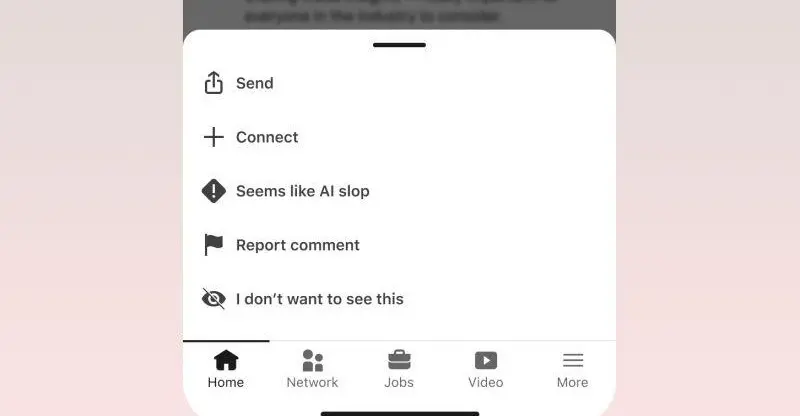
LinkedIn’s most unusual new feature — a button designed to mark posts as “AI slop” — has already been clicked by more than one million members, the company said. The reporting control was introduced on July 30, and chief product officer Hari Srinivasan shared the early milestone in a Thursday post on LinkedIn. He also described a wider turnaround: LinkedIn now says users are seeing roughly 40 percent fewer views of content classified as AI slop than they did only a few weeks ago.
The phrase “AI slop” has become one of the most debated issues in social media. It usually means generic, low-effort text generated by an AI model, often repackaged for engagement instead of insight. On LinkedIn, where posts are meant to demonstrate professional expertise, the phenomenon has been particularly damaging. Users have joked about spotting automated “inspirational” posts, formulaic career advice, and hollow company updates. The one-million-click figure suggests the button is not just a novelty; it is meeting real demand from members who want the platform to do something about the noise.
How the new feature works
The button lives in the same three-dot menu that LinkedIn members already use to report spam, block accounts, or unfollow someone. When a user chooses “Seems like AI slop,” LinkedIn interprets it as a signal that the post lacks the human context, experience, voice, or original perspective expected in a professional conversation. The button does not immediately hide or delete a post. Instead, it is combined with automated classifiers that determine whether a post should be shown less frequently, removed from recommendations, or passed over by the algorithm in feeds.
LinkedIn also plans to show a new message to people who publish flagged posts. The message will reportedly tell an author: “Some members told us this post seems like AI.” The goal is not to shame users but to give them useful feedback about how their content is being received. Srinivasan said the team approached the feature “assuming good intent,” and he admitted that the boundary between AI-assisted writing and AI-generated slop can be awkward. He said he is “increasingly conscious” of how to avoid sounding like AI, suggesting that even LinkedIn’s own executives are paying close attention to the issue.
Why the button was introduced
LinkedIn’s timing also mattered. The company had faced criticism after a widely circulated report said a large share of long-form posts on the network were probably created by AI. The analysis, based on an outside detection service, claimed that 41 percent of LinkedIn’s longform posts could be classified as fully AI generated. That report gave many users a vocabulary to describe what they had been seeing for months: content that looked almost like normal professional advice but came from an AI model rather than from lived experience.
Before the new button, LinkedIn had already begun testing ways to distinguish AI-generated posts from human writing, but those tools were not always visible or easy for regular members to control. The one-click button gives everyday users a direct way to influence what appears in their feed and, by extension, in the feeds of others. LinkedIn does not share precisely how the reports are weighted, but feedback like this often plays a role in recommendation systems: repeated reports from diverse accounts can cause a post to be sent to a review queue or to have its reach reduced automatically.
LinkedIn’s AI cleanup
The AI slop button is only one part of a broader effort. In the same announcement, LinkedIn said it had added new classification systems designed to identify AI-generated posts and reduce their distribution. The company also removed a feature that encouraged users to “enhance your post” with AI. That tool had been criticized by users who felt it pushed automation into the center of the publishing experience, even though many professionals wanted to be able to post original thoughts quickly.
Between the new classifiers, the removed “enhance” option, and the feedback button, LinkedIn appears to be signaling a change in direction. Generative AI is still valuable for drafting, editing, summarizing, and translating ideas, but LinkedIn’s product leaders seem to understand that a feed made of indistinguishable AI content is bad for engagement in the long run. If users cannot tell whether advice is authentic, they may stop trusting the network entirely. That is a serious risk for a company whose business depends on professional credibility.
Author feedback could change behavior
The upcoming notification to authors represents an interesting shift. Rather than publicly labeling a post or placing a visible badge next to it, LinkedIn will contact the author privately. This gives writers a chance to revise or explain their approach. It also encourages people who rely on AI for content to spend more time adding personal details, specific examples, and plain-language statements that only a real professional would know.
That approach aligns with what LinkedIn has said about “assuming good intent.” Many users may not realize that a post they wrote with AI sounds too generic or reads like a list of buzzwords. A direct private note could be more educational than a public punishment. The note may also help over time: if an author repeatedly ignores the feedback and continues posting content that users flag, LinkedIn could take stronger action. The company has not said what repeated offenses trigger, but the reporting system gives it enough data to make that decision.
A broader fight against engineered content
The new button is also part of LinkedIn’s wider attempts to reduce automated engagement. Earlier this year, LinkedIn announced that it would crack down on comments created at scale with limited human involvement. That policy targets another popular network tactic: flooding a post with AI-generated comments that say “Great insight!” or “This is exactly what I needed to read today!” Such comments can make a post appear more popular than it really is and drown out meaningful discussion. By acting on both AI posts and AI comments, LinkedIn is trying to preserve the conversational quality that separates it from other social platforms.
Still, the effort is not simple. AI tools have become widely embedded in everyday work routines, and many LinkedIn users write with help from ChatGPT, Claude, Gemini, or other assistants. A writer might provide all of the ideas and structure but ask an AI to smooth the grammar. Another person might enter a few bullet points and let an AI generate an entire story with no original sentences. Between those two examples lies a large gray area. Automated classifiers are unlikely to judge intention perfectly. The new member feedback could introduce human judgment into a challenge that algorithms alone cannot solve.
LinkedIn’s reported 40 percent reduction in views of classified AI slop is also hard to interpret. It could mean that the classifiers are now catching more AI content, that the button has caused credible users to post less automated content, or that the algorithm is suppressing posts before they gain traction. The company did not share absolute numbers, so the percentage may reflect a mix of causes. Still, the fact that LinkedIn says the figure has moved at all suggests the platform can change behavior through a combination of detection, feedback, and consequence.
Implications for creators and marketers
For LinkedIn influencers, freelancers, and marketing teams, the rise of the AI slop button is a clear warning: generic AI content will no longer perform the way it did in the early wave of generative tools. Tools that promise to “write viral posts for LinkedIn” still exist, but their output is now more likely to be classified as low quality. Brands that publish generic content may see their reach shrink, while creators who reveal personal experience and original insight could benefit from less competition.
LinkedIn seems to be betting that members would rather read fewer, more useful posts than be overwhelmed by quantity. If more than one million people are willing to tap a button labeled “Seems like AI slop,” the platform has credible evidence that members care strongly about the issue. The next few weeks will show whether LinkedIn can turn that frustration into a cleaner, more trustworthy professional feed. With the new message for authors, another signal has been added: people are watching whether their words sound like they were written by a sensitive professional or generated by a machine and posted with no further thought.
Source: The Verge News