

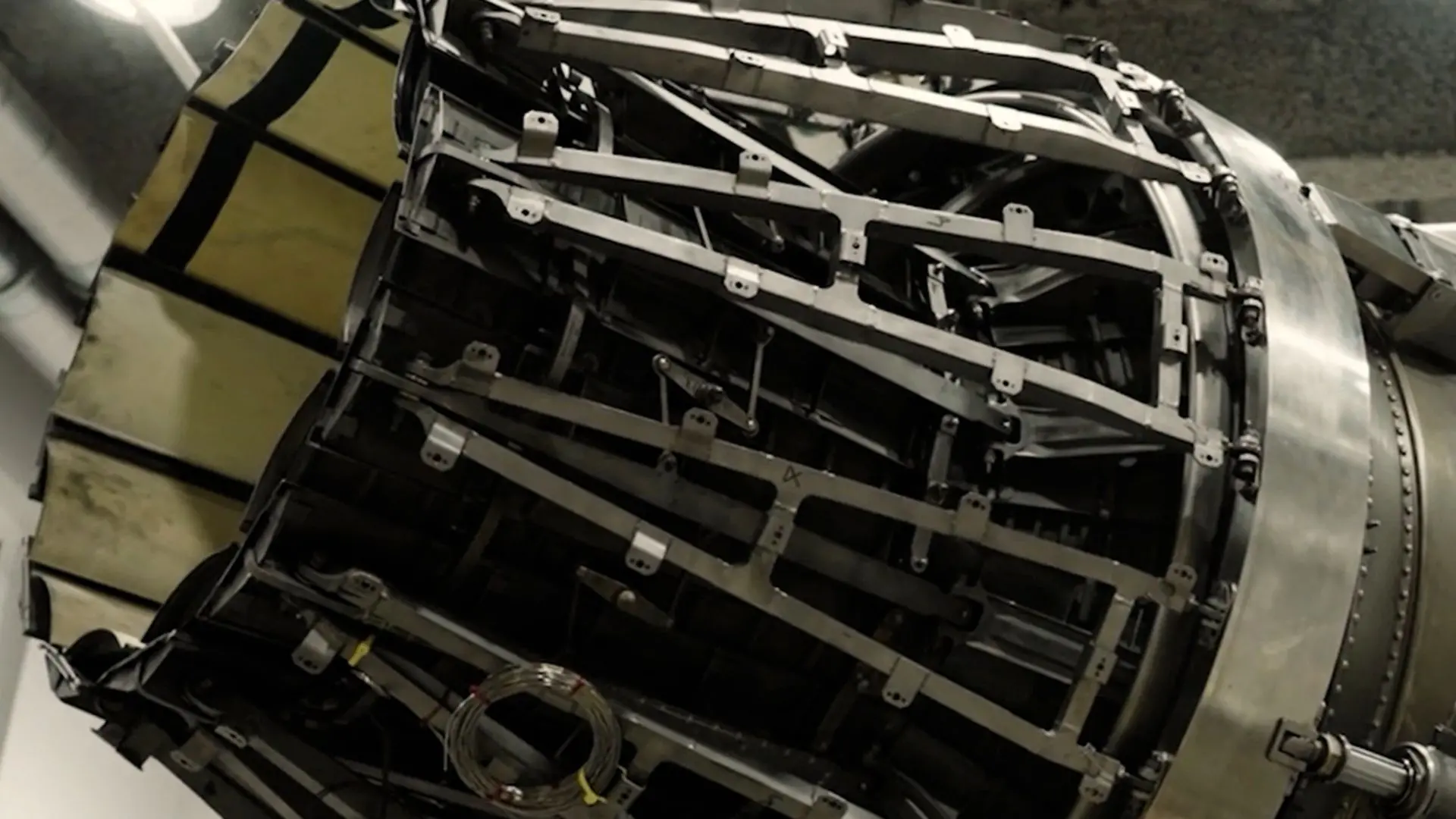
Defense engineers have selected a 36-year-old powerplant originally developed for the F-16 Fighting Falcon to drive a far younger aircraft: the world's first artificial intelligence-piloted vertical takeoff and landing fighter. The announcement connects two eras of military aviation. On one side is an engine from the 1980s whose reliability and thrust have been proven over decades of combat. On the other is a new generation of autonomy software that can fly and fight without a human hand on the controls.
Program officials describe the engine choice as a deliberate move to lower risk without lowering capability. The F-16 engine has one of the widest maintenance and logistics footprints in the Western fighter fleet. Thousands of examples have been built, repair depots know every major component, and operator experience is already global. By placing that engine into an AI-piloted vertical takeoff and landing airframe, designers can concentrate their development budget on autonomy, flight controls, and vertical-lift integration rather than creating an unproven propulsion system from scratch.
Key facts at a glance:
- The aircraft will use a proven 36-year-old engine from the family originally developed for F-16 fighters.
- It is described as the world's first AI-piloted VTOL fighter, combining vertical takeoff and landing capability with fixed-wing speed.
- The engine is an afterburning turbofan with a long combat record in air-superiority, strike, and suppression missions.
- The onboard AI pilot is expected to manage takeoff, landing, and combat maneuvers, reducing risk to human aviators.
A proven powerplant from the F-16 era
To understand why an older engine is making news, it helps to remember why the F-16 needed a revolutionary powerplant in the first place. The F-16 was designed to be small, cheap, and highly maneuverable, but early production models were powered by engines that sometimes struggled with the demands of aggressive dogfighting and rapid throttle movement. Military planners wanted an alternative that could deliver more thrust and better response across a wider range of flight conditions.
The engine now linked to the AI-piloted VTOL project emerged from that push for options. It belongs to the generation of afterburning turbofans that gave the F-16C and F-16D greater combat flexibility. By using a larger fan and a more efficient core, it produced more thrust at lower temperatures and with better fuel economy. That made the aircraft harder to stall in a fight, quicker to accelerate, and more capable with heavy weapon loads. The design also opened the door for the F-16 to carry out missions far beyond the close-range air-combat role originally imagined for it.
What makes the engine especially attractive today is not merely its performance but its maturity. In aviation, a new engine can require years of testing before it is accepted for combat. This engine is already past that barrier. It has been run, rebuilt, modified, and improved for more than three decades. Operators around the world maintain the skills needed to service it. The spare-parts pipeline is dense. In a military environment where reliability is often more important than raw speed, choosing a mature engine can be the safest possible decision.
Why an AI-piloted VTOL fighter changes the equation
The aircraft itself represents a more recent ambition: to remove the pilot from missions that are too repetitive, too dangerous, or too likely to be contested. A vertical takeoff and landing fighter does not need a long runway, a catapult, or an arresting gear. It can operate from small decks, clearings, roadways, or forward bases. That flexibility matters because modern anti-access systems threaten the large airfields on which traditional fighters depend.
But VTOL flight places brutal demands on any propulsion system. Hovering consumes enormous energy. Transitioning from a vertical hover to wingborne forward flight requires precise control of thrust, pitch, and attitude. If anything goes wrong during that transition, the margin to recover can be measured in seconds. An engine with a slow throttle response can make a hover unstable. An engine without enough reserve thrust can leave the aircraft unable to arrest a descent or climb away from an obstacle. The chosen F-16-derived powerplant offers the high thrust-to-weight ratio and rapid response that vertical flight requires.
There is also a historical connection between fighter engines and vertical flight. Some of the first attempts at vertical takeoff fighters used powerful jet engines to drive lift fans, direct exhaust downward, or rotate nozzles. Those efforts taught engineers that the engine is only part of an integrated flight-control problem. It must work with the airframe's flight computer, sensor suite, and control surfaces to keep the aircraft balanced near zero airspeed. That lesson is now being applied to a machine whose entire flight envelope may be managed by an artificial intelligence pilot.
What the AI pilot adds to a fighter airframe
The phrase AI-piloted can be misleading. Many remotely piloted aircraft already take off and land without direct human stick inputs. Autopilots can fly headings, altitudes, and navigation routes. The new development is a higher degree of decision-making autonomy. An AI pilot does more than maintain a steady course; it is being designed to interpret the battlefield, choose maneuver sequences, and execute tactical actions in real time.
For a vertical takeoff and landing fighter, that means the AI must handle the hardest parts of flight without relying on a ground controller to assist every movement. It must sense wind, temperature, and obstacles during takeoff. It must decide when the aircraft has enough airspeed to transition from vertical to horizontal flight. It must also know how to abort that transition if an engine malfunction, a control-surface failure, or an unexpected threat appears. These are not simple programming tasks. They require machine-learning systems trained on large amounts of flight data, as well as conventional software built to guarantee safe behavior.
Military autonomy also raises questions about trust. A pilot in a cockpit can feel the aircraft's vibrations, hear its engine, and instantly judge whether something is wrong. An AI pilot relies on sensors and electronic signals. For this reason, the first AI-piloted VTOL fighter is unlikely to be given total freedom from the beginning. Developers will almost certainly test the autonomy in progressively more difficult stages, beginning with ground taxi tests, then tethered hovers, then full transitions, and finally combat-like maneuvers.
A military role that does not need a runway
Defense analysts see several roles for an AI-piloted VTOL fighter. The most obvious is expeditionary operations from small ships. Many navies operate vessels with flight decks large enough for helicopters but not for conventional jet fighters. An AI-piloted fighter with vertical takeoff and landing capability could give those ships a fast, armed air asset without requiring a flattop carrier or a catapult system.
A second role is distributed operations in the Pacific and other island-heavy regions. Rather than concentrating fighter aircraft at a few large bases, a VTOL fighter could operate from temporary runways, austere airstrips, and even cleared sections of highway. That makes it harder for an adversary to target the aircraft before it can get airborne. The same engine that once defended NATO airspace may spend its final years operating from remote islands or frontline expeditionary sites.
The aircraft could also support special operations and search-and-rescue missions. Hovering capability allows it to loiter over a location, observe a target, and engage with precision weapons. Should the mission require retrieval of a downed pilot or a time-sensitive target, the AI can respond faster than a remotely piloted system waiting for instructions from a ground station. The lack of a human pilot also means the airframe can be designed around sensors and fuel rather than around cockpit ergonomics, ejection seats, and pilot life-support systems.
What a 36-year-old jet engine can still provide
It is tempting to judge an engine by its age, but jet engines do not age like consumer electronics. Military engine designs are continually modified through service-life extensions, new turbine materials, upgraded digital controls, and improved cooling technologies. An engine that first flew decades ago can still embody a sophisticated balance between airflow, compression, combustion, and thrust. The engine in question has also proven that it can absorb battle damage and still return the aircraft to base, a quality that autonomous systems cannot easily replicate because the aircraft has no pilot aboard.
The choice of a proven engine could also accelerate certification. In military aviation, a new engine-airframe combination requires extensive ground testing, flight testing, and environmental testing. By using an engine with a long safety and performance history, the VTOL fighter team can focus on the unknowns that truly matter: autonomy software, vertical flight control laws, and human-machine trust. Fewer unknowns usually mean a shorter path to deployment.
There are challenges, however. A 36-year-old engine design may not offer the same fuel efficiency as newer engines scheduled to enter service in the coming decade. It may require more maintenance hours per flight hour. Its exhaust temperature might limit the kinds of deck coatings or surfaces from which it can operate in vertical mode. And because the aircraft is unmanned, any engine failure that results in the loss of the airframe may still carry high financial consequences, especially if the aircraft is carrying advanced sensors or weapons.
There is also the broader question of whether the world needs an AI-piloted fighter today. Opponents of such programs argue that autonomous aircraft can be jammed, spoofed, or hacked. They note that no algorithm has yet demonstrated the full creativity and judgment of an experienced fighter pilot in a chaotic dogfight. Supporters counter that human pilots are becoming the most vulnerable element of a combat aircraft. They point to the growing cost of pilot training, the need to strike targets in high-risk environments, and the possibility of using swarms of cheaper autonomous aircraft to overwhelm defenses.
That debate will continue long after the first prototype reaches vertical hover. What is clear is that the project has chosen a deliberately conservative path in one of the most exciting, experimental corners of aviation. Instead of betting on a mysterious powerplant or a futuristic energy source, the designers are betting on a familiar engine that has already survived generations of pilots, wars, and technical revolutions. The next generation of that engine will now be asked to carry a different kind of fighter into a different kind of battlespace.
If the program succeeds, it will demonstrate that revolutionary progress in military aviation does not always require sending more money to an engine factory to build a new core from scratch. Sometimes the fast path to the future is found by taking a proven source of power from an older fighter and handing it to an artificial mind that has never known
Source: TechRadar News