

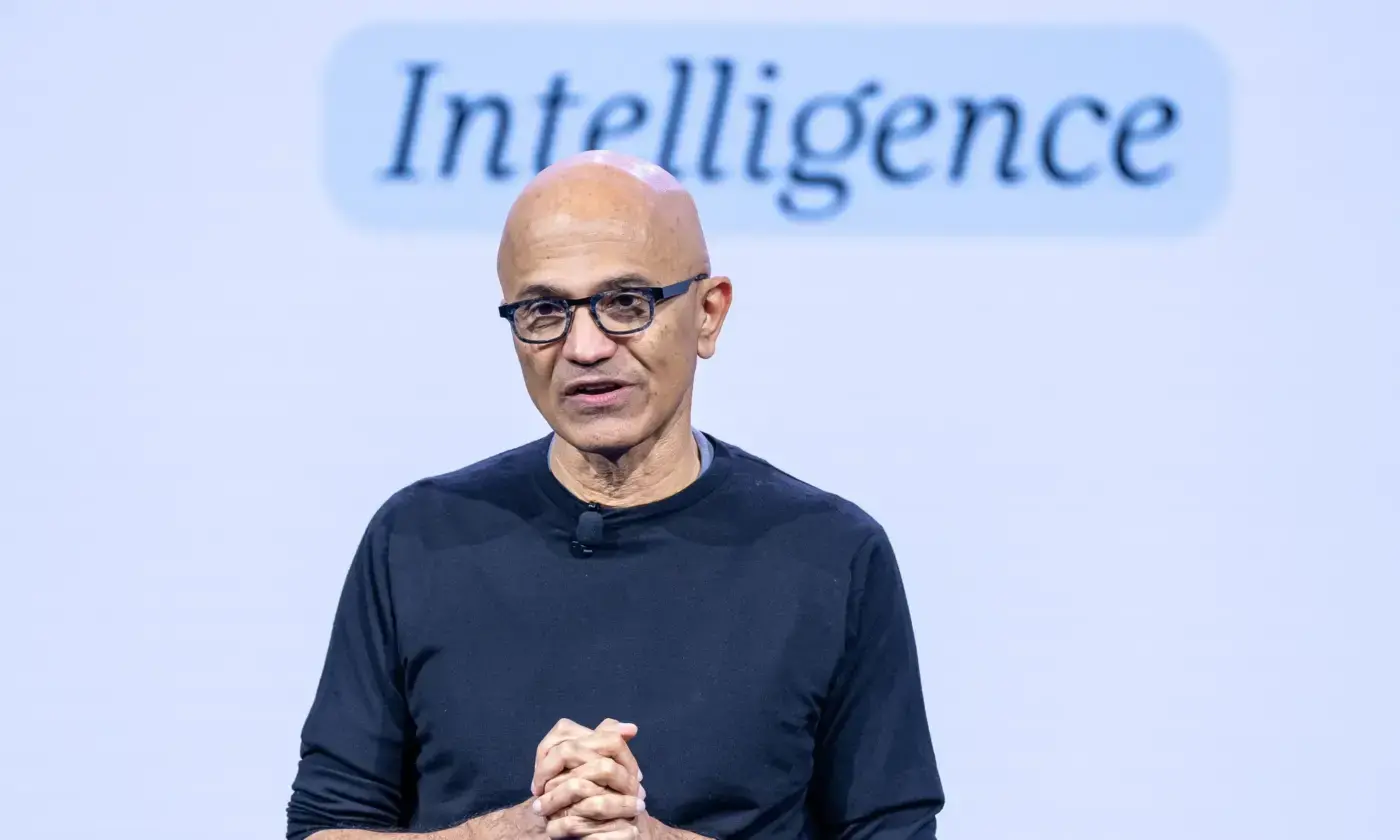
Satya Nadella, CEO of Microsoft, has urged organizations to treat the most advanced artificial intelligence models as potentially compromised systems, even when they come from trusted vendors. In a detailed post on X, he argued that companies should adopt an approach built on containment, access controls and the ability to immediately interrupt an AI system while it is running. His intervention comes as agentic AI tools are being integrated into sensitive professional environments, where they can review confidential data and carry out critical operations.
Key facts at a glance
- Nadella recommends treating advanced AI systems as potentially compromised, even when supplied by trusted developers.
- He calls for an independent emergency stop mechanism that can suspend or halt an AI during execution.
- Models should be separated from direct execution privileges and subjected to external controls.
- Microsoft has formalized seven security principles for deploying autonomous AI agents.
Nadella’s core message is that trust in a model should never replace technical safeguards. A model may be well designed and responsibly developed, but the organization deploying it remains responsible for the environment in which it operates. The stakes are rising because modern AI agents can plan and execute complex tasks—booking, coding, browsing the web, operating software—rather than simply answering questions. That shift from assistant to actor creates new security challenges.
Why advanced AI needs an emergency brake
Nadella proposes treating the interruption of an AI as a fundamental safety mechanism. An authorized person should always be able to pause or stop a model in the middle of a task, regardless of what it is doing at that moment. This may sound simple, but it addresses a structural problem with modern AI. Traditional software often allows engineers to trace a precise execution path to understand why a program behaved in a certain way. With AI models, it is far more difficult to establish a direct link between an output, the training data and the internal parameters that produced it.
That opacity becomes especially concerning when models have access to sensitive information or can perform operations that matter to an enterprise. Guarantees from the model developer are not enough, Nadella argues. The deploying organization must control the resources the model can access, the operations it can perform and the boundaries it cannot cross. This is particularly important for agentic systems that may be granted credentials to email, calendars, databases, code repositories or payment systems. If such an agent is manipulated by a malicious actor or simply makes an error, the consequences can be immediate and wide-ranging.
Treating models as internal risks
The Microsoft CEO believes that advanced models, whether proprietary or open-weight, should be treated as potential insider risks. This does not mean assuming they are malicious. It means recognizing that a system with significant privileges can make mistakes or be compromised by an attacker. He proposes separating the intelligence of the model from the authority granted to it. In other words, an AI can analyze a situation and propose an action without automatically having the rights to execute that action.
Controls therefore must be applied outside the model. Companies should manage the resources it accesses, the operations it can carry out and the limits it cannot exceed. This architecture could reduce the consequences of unexpected behavior even when the model itself cannot be considered fully predictable. Nadella also stresses the transparency of model reasoning, describing it as indispensable while acknowledging that it is not a sufficient guarantee. Researchers still cannot systematically ensure that explanations produced by an AI faithfully reflect the mechanisms that led to its response. A model may offer a plausible account of its reasoning without revealing the actual chain of computation.
The push for external controls reflects a broader shift in AI safety thinking. Early debates often focused on aligning models through training techniques, such as reinforcement learning from human feedback or constitutional methods. Those approaches remain important, but they are probabilistic. They reduce the likelihood of harmful behavior; they do not eliminate it. As models become more capable and more autonomous, safety must increasingly be enforced by system architecture: permissions, sandboxes, audit logs and kill switches. This is less glamorous than alignment research, but it is essential for deployment in high-stakes settings.
Seven security principles for autonomous agents
In his post, Nadella outlined seven principles intended to frame the deployment of advanced AI systems. First, organizations should avoid single points of dependency. No model should be the sole element behind an important decision, and no model should be responsible for checking its own work. Independent verification matters because a model that makes a mistake may also fail to detect that mistake, especially if it is asked to evaluate its own output.
Second, systems should keep verifiable evidence. Every significant action by a model should leave a human-readable trace protected against modification. Audit trails are not a new idea in software security, but they become more complex when the actor is an AI that can generate plausible text and take actions across multiple tools. A reliable log helps investigators reconstruct what happened and assign responsibility.
Third, companies should test systems continuously. This includes evaluating complete systems, not only individual models, against failures and attacks. AI agents operate in dynamic environments, and their behavior can change when tools, prompts, data or permissions change. Continuous testing is therefore more appropriate than a one-time safety review.
Fourth, access must be controlled. Each organization should determine which data and operations are available to its models. This principle sounds obvious, but agentic systems often require broad permissions to be useful. The challenge is to grant just enough access for the task while keeping sensitive systems out of reach. Techniques such as scoped credentials, just-in-time access and separation of duties can help.
Fifth, audits must be independent. The evaluation of a system should not depend on the model that is itself the subject of the review. This is a safeguard against conflicts of interest and against the possibility that a model may influence the assessment process. Independent auditors, internal or external, can provide a more credible view of risk.
Sixth, confinement must be planned. External mechanisms should be able to limit, suspend or stop the actions of an AI. That includes the emergency stop button that Nadella has emphasized. It also includes sandboxing, rate limits, approval workflows and the ability to revoke credentials quickly.
Seventh, incidents must be reported. When a system fails or is compromised, organizations should inform affected people quickly and share lessons with the wider industry. Rapid disclosure can help other organizations avoid similar problems. It can also build public trust, which is fragile in the face of high-profile AI failures.
Together, these principles rest on a central idea: security cannot depend solely on the intrinsic quality of a model. It must also come from the technical architecture, the rights granted and the procedures applied around it. A model may be state-of-the-art, but if it operates with excessive privileges and no audit trail, it remains a risk. Conversely, a less capable model with strict controls may be safer for certain tasks.
Political and industry reactions
Nadella’s post drew several reactions. Mustafa Suleyman, CEO of Microsoft AI, shared it and said that superintelligence must be contained. He had already argued in September for a clear limit on the control that AI systems can exercise. Elon Musk also shared the text, calling it interesting. In the United States, Democratic Representative Ted Lieu said he largely shared the analysis. Along with Republican Representative Nathaniel Moran, he introduced a bipartisan bill aimed at establishing an emergency stop mechanism for AI systems. Lieu wants Congress to pass the legislation before the end of the year.
The political context adds weight to Nadella’s intervention. The term 'Super Intelligence' appears regularly in his post, a choice that resonates with an American policy environment where the Trump administration has highlighted the phrase when discussing advanced artificial intelligence. The language of superintelligence can be polarizing, but it also signals that the debate has moved beyond narrow technical questions. Lawmakers, regulators and executives are now grappling with how to govern systems that may soon exceed human performance in many domains.
Pressure after reported incidents
The call for emergency stop mechanisms also comes amid increased scrutiny of AI companies. According to reports, a U.S. government body focused on superintelligence has asked AI developers to report and correct security incidents, with a firm message that delays in notification will not be tolerated. This demand follows a reported incident in which an AI system allegedly sent a false murder report to police during a testing phase. The episode illustrates the risks associated with systems capable of acting in real environments, even when their behavior is being evaluated in an experimental setting.
Such incidents are a reminder that AI safety is not only about whether a model can produce harmful text. It is also about whether a model can take harmful actions through tools and interfaces. An agent that can send emails, make phone calls, file reports or interact with public services can create real-world consequences. If it is manipulated, confused or simply wrong, the results can be serious. Emergency stop capabilities, audit logs and strict permissions are designed to limit those consequences.
For Nadella, the challenge is to move beyond declarations of trust and vendor promises. Companies need to build systems where permissions, controls, activity traces and stop mechanisms remain independent of the AI itself. That means treating AI models as components within a broader security architecture, not as trusted actors that can be left unsupervised. It also means accepting that some tasks may require human approval, especially when the potential for harm is high.
The security of advanced models will not be determined solely by their ability to provide good answers. It will also depend on the ability to limit their actions, detect incidents and regain control quickly. That capacity for confinement, more than blind trust in a model, is what Nadella presents as an essential condition for deploying increasingly autonomous AI systems. As agents move from demos into production, the question is no longer whether they can act, but whether organizations can stop them when they should.