

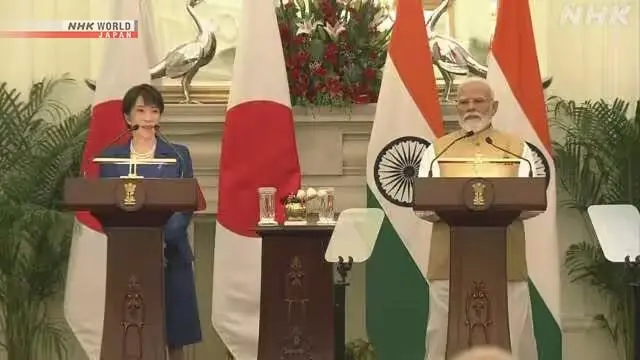
Japanese Prime Minister Takaichi Sanae has concluded her bilateral summit talks with Indian Prime Minister Narendra Modi, marking a significant milestone in the strategic partnership between the two nations. During the meeting, Takaichi announced approximately $12 billion in investments aimed at fostering new business ventures and strengthening the economic footprint of Japanese enterprises in India.
Speaking to journalists after the talks, Takaichi stated, "Japan and India will leverage each other's strengths to become strong and prosperous nations. Given the instability in the international situation, it is increasingly important to establish this type of mutually complementary cooperation. Today, Prime Minister Modi and I had various discussions with this perspective. I reaffirmed that we share many common goals."
The announcement comes at a critical time for both countries as they navigate a complex geopolitical landscape. India, with its rapidly growing economy and strategic location in the Indo-Pacific, has become a key partner for Japan. Over the past decade, bilateral trade and investment have surged, with Japan emerging as one of the top sources of foreign direct investment into India.
Economic Cooperation and Business Agreements
Takaichi highlighted that companies from both nations had exchanged approximately 130 memoranda of understanding and cooperation agreements. These accords span sectors such as technology, infrastructure, energy, and manufacturing. The agreements are expected to facilitate technology transfers, joint ventures, and capacity building efforts, particularly in India's ambitious 'Make in India' and 'Digital India' initiatives.
Japanese investment in India has historically focused on automotive, electronics, and heavy machinery industries. However, the new wave of investment is likely to target emerging sectors like electric vehicles, semiconductors, green hydrogen, and artificial intelligence. The $12 billion package includes commitments from both government-backed institutions and private corporations, with a focus on creating manufacturing hubs in Indian states such as Gujarat, Tamil Nadu, and Maharashtra.
A notable feature of the economic partnership is the development of the Delhi-Mumbai Industrial Corridor (DMIC), a flagship project supported by Japan. The corridor is designed to create a high-tech industrial zone linking the capital with the financial hub, featuring world-class infrastructure, smart cities, and logistics networks. Progress on the DMIC has been a key item on the bilateral agenda, and the new investments are expected to accelerate its completion.
Maritime Security and Strategic Alignment
Takaichi also discussed enhanced security cooperation, particularly in the maritime domain. Both nations share concerns about freedom of navigation and stability in the Indo-Pacific region. Japan and India are natural partners in efforts to counterbalance China's growing assertiveness in the South China Sea and the Indian Ocean.
The India-Japan Maritime Security Dialogue has been a platform for coordinating naval exercises, intelligence sharing, and capacity building. In recent years, the two countries have participated in the Malabar naval exercises alongside the United States and Australia. Takaichi's reaffirmation of cooperation signals a deepening of their strategic partnership, which also includes dialogues on cyber security, counter-terrorism, and space security.
Prime Minister Modi has long advocated for a free, open, and inclusive Indo-Pacific. Japan's vision of a 'Free and Open Indo-Pacific' (FOIP) closely aligns with India's Act East policy. The two leaders have committed to strengthening interoperability between their armed forces and conducting more joint patrols in critical sea lanes.
Background: Takaichi Sanae's Rise and Policy Priorities
Takaichi Sanae is a veteran politician of Japan's Liberal Democratic Party (LDP) and made history as Japan's first female prime minister. Her political career has been marked by a focus on economic revitalization, national security, and technological innovation. Before becoming prime minister, she served in various key cabinet positions, including Minister of Internal Affairs and Communications and Minister of State for Women's Empowerment.
Her government has prioritized strengthening alliances with like-minded democracies, and the partnership with India is a cornerstone of this policy. Takaichi has emphasized the need for Japan to play a more proactive role in global affairs, balancing economic resilience with military deterrence. Her visit to India signals a continuation of the strategic trajectory set by previous administrations under Shinzo Abe and Fumio Kishida.
In domestic policy, Takaichi has championed the concept of 'New Capitalism', which seeks to bridge the gap between market efficiency and social welfare. She has also pushed for a digital transformation of Japan's economy, focusing on artificial intelligence, quantum computing, and green energy. These priorities align with India's own developmental goals, creating synergies for collaboration.
Historical Context of India-Japan Relations
The modern India-Japan relationship dates back to the post-World War II era, but its strategic dimensions have intensified over the last two decades. The two countries established a 'Global Partnership' in 2000, which was upgraded to a 'Special Strategic and Global Partnership' in 2014. The partnership is based on shared democratic values, legal systems, and a commitment to multilateralism.
Cultural and people-to-people ties have also deepened, with Buddhism acting as a historical bridge. In recent years, the Indian diaspora in Japan has grown, and tourism between the two countries has increased significantly. The Japan Foundation and the Indian Council for Cultural Relations have sponsored various exchange programs in arts, education, and science.
In the economic sphere, Japan has been a major donor of official development assistance (ODA) to India, funding infrastructure projects such as the Delhi Metro, the Mumbai-Ahmedabad High-Speed Rail, and various power generation facilities. Japan's ODA to India is among the highest for any recipient country, reflecting the importance New Delhi holds in Tokyo's foreign policy.
Economic Forum and Industry Participation
Concurrent with the summit, an economic forum was held in India on Thursday evening, featuring representatives from over 150 Japanese companies. The forum provided a platform for business leaders to discuss investment opportunities, regulatory reforms, and sector-specific challenges. The high level of participation underscores the strong interest of Japanese corporations in the Indian market.
Key sectors highlighted at the forum included renewable energy, healthcare, digital infrastructure, and advanced manufacturing. Japanese companies are increasingly looking to India not just as a market but as a production base for exports to the wider region. The Indian government has been actively working to improve ease of doing business, reduce taxation complexities, and streamline labor laws, making the country more attractive to foreign investors.
Japanese firms such as Toyota, Suzuki, Sony, and Hitachi have already established significant operations in India. The new agreements are expected to facilitate the entry of smaller and medium-sized enterprises that often face barriers in navigating foreign markets. The Japan External Trade Organization (JETRO) and the Indian Ministry of Commerce have been instrumental in arranging matchmaking sessions and providing legal assistance.
Future Outlook: Challenges and Opportunities
While the investment announcement is promising, both nations face several challenges in realizing their goals. Infrastructure bottlenecks, land acquisition issues, and bureaucratic delays remain concerns for Japanese investors. The Indian government has acknowledged these issues and is working on reforms, but progress has been uneven.
On the security front, the Quadrilateral Security Dialogue (Quad) involving Japan, India, the United States, and Australia has become a focal point for coordinating responses to regional threats. However, maintaining unity among the Quad members, especially with changing political landscapes in the U.S. and Australia, requires constant diplomatic effort. Takaichi and Modi have both expressed a strong commitment to the Quad's principles, but practical implementation will test their resolve.
The two leaders also addressed the potential for cooperation in Africa and the Middle East, where India and Japan have significant interests. Joint infrastructure projects in third countries could become a new dimension of their partnership. For example, the Asia-Africa Growth Corridor, proposed by India and Japan, aims to promote connectivity and development across the African continent, offering an alternative to China's Belt and Road Initiative.
In the field of technology, collaboration in 5G and 6G networks, cybersecurity, and space exploration is likely to expand. Japan's expertise in satellite technology and artificial intelligence can complement India's strengths in software development and space engineering. The two countries have already collaborated on lunar exploration and earth observation missions.
Environmental sustainability is another area where Japan and India are aligning their efforts. India's ambitious targets for renewable energy capacity and Japan's leadership in hydrogen technology present mutual benefits. The leaders discussed launching joint research and development programs for green hydrogen and carbon capture technologies.
Finally, the personal rapport between Takaichi and Modi has been noted by diplomats as a positive factor. Their shared vision of Asia's future and their pragmatic approaches to problem-solving have facilitated the signing of multiple agreements. The summit has set the stage for the next round of annual bilateral consultations, which are expected to focus on implementing the agreements reached and monitoring progress.
The strengthening of Japan-India ties comes as global power dynamics shift, with multipolarity becoming more pronounced. Both nations see in each other reliable partners who can help navigate the uncertainties of the 21st century. The $12 billion investment commitment and the 130 cooperation agreements are not just financial figures; they represent a strategic bet on the potential of Indo-Pacific cooperation.
Source: NHK WORLD News