

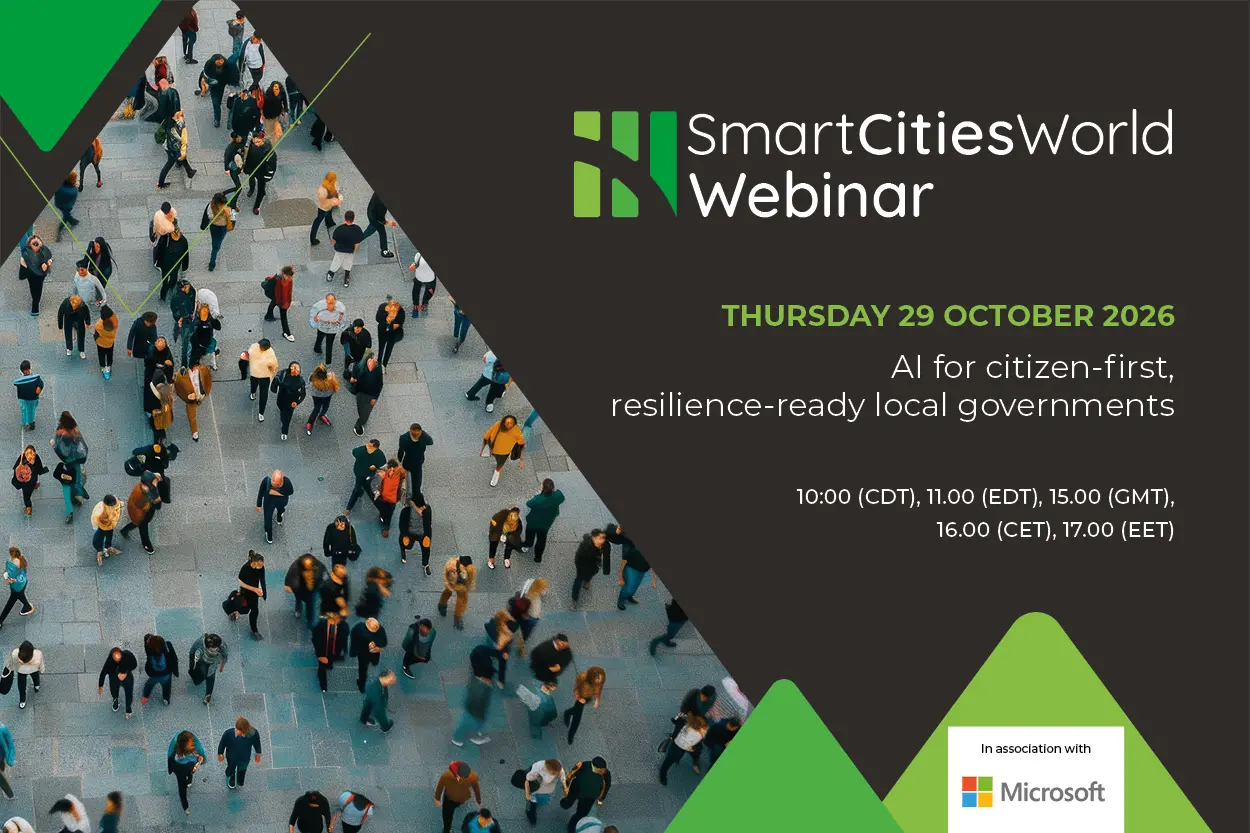
A webinar on 29 October will explore how connected data and artificial intelligence can help local governments become more citizen-first and resilience-ready. The session is designed for urban leaders, public-sector technology teams and partners who are trying to move from strategy to practical action. Its central message is that AI is not an end in itself; it is a means of helping councils and city agencies understand residents' needs, break down departmental silos and make faster, better-informed decisions.
The discussion arrives at a moment when local governments are under pressure from several directions at once. They are expected to improve services, demonstrate fiscal discipline, protect vulnerable residents and prepare for climate-related shocks. At the same time, they are collecting more data than ever from sensors, cameras, service requests, transport systems, buildings and digital channels. The webinar will ask how that data can be governed and used responsibly so that it improves public outcomes rather than adding to operational complexity.
Key facts
- The webinar takes place on 29 October and focuses on AI for citizen-first, resilience-ready local governments.
- Topics include connected data, citizen engagement, breaking down departmental silos and faster, better-informed decisions.
- The session will examine AI, edge computing and computer vision as tools for turning growing volumes of urban data into smarter, faster decisions and more responsive services.
- Climate change, infrastructure resilience and digital transformation form the backdrop for the discussion.
- A 2026 smart cities summit during London Climate Action Week will bring urban leaders and partners together to explore how these agendas intersect and how cities can translate strategy into practical action.
- Malaysia is highlighted for AI-powered urban innovation ahead of the first Southeast Asian smart city expo in Kuala Lumpur.
- Singapore is cited as one of the world's leading smart nations, while Sunderland is repositioning itself through digital infrastructure and low-carbon innovation.
- A podcast discussion with an urban innovation expert examines how AI is moving from pilots to real-world impact, the Global Smart City Index and an emerging AI super gap between cities.
- Smart sensor networks are spotlighted for indoor safety, early risk detection, situational awareness and healthier, more secure and sustainable buildings.
- A 20 October panel discussion will focus on cognitive cities and smarter, more responsive urban systems.
For local authorities, the citizen-first label is a test of priorities. A city can deploy sophisticated models and still fail if residents cannot access services, do not trust how their data is used or find that automation makes it harder to reach a human decision-maker. The webinar is expected to frame AI as part of a wider operating model: one that joins up front-line services, planning, housing, transport, environmental health and emergency response. Breaking down silos is therefore not just an internal efficiency goal. It is a precondition for spotting risks earlier, targeting support more accurately and giving residents a consistent experience across departments.
Connected data is the foundation of that model. Cities often hold valuable information in separate systems that were procured at different times and designed for different purposes. An AI-ready city needs data platforms that can bring these sources together with clear rules on quality, ownership and access. It also needs governance that answers difficult questions before a crisis: who can use data, for what purpose and under what safeguards. The 29 October session will consider how data platforms and AI-ready infrastructure can support decisions in real time, from identifying a failing asset to adjusting a service in response to demand.
Edge computing and computer vision are likely to feature prominently in the technical discussion. Edge computing allows data to be processed close to where it is generated, which can reduce latency and limit the amount of raw data that must be sent to central systems. In a local government context, that could support faster responses to road hazards, crowded public spaces or building safety alerts. Computer vision can help turn video and images into usable information, such as detecting blocked routes, abandoned waste or changing conditions in public areas. The ethical and operational questions are just as important as the technology: cities need transparency, privacy protections and human oversight so that these tools strengthen public trust rather than eroding it.
Resilience is another central theme. Climate change is increasing the frequency and severity of heatwaves, flooding, storms and other shocks. Infrastructure resilience depends on knowing where vulnerabilities lie and how services will perform under stress. Digital transformation can help, but only if systems are designed for continuity, interoperability and cyber resilience. The webinar will connect these agendas by looking at how AI can support scenario planning, asset management, emergency coordination and long-term investment decisions. The aim is not simply to predict disruption but to help local governments prepare for it and recover more quickly.
The broader city agenda shows why the discussion matters beyond one session. A 2026 smart cities summit during London Climate Action Week is expected to bring urban leaders and partners together to examine the intersection of climate action, infrastructure and digital transformation. That event will focus on how cities can turn strategies into practical action, a challenge that many local governments recognize. Strategies often exist; the harder work lies in procurement, skills, governance, funding and change management. The 29 October webinar is positioned as a way to explore those implementation questions before larger gatherings take up the same themes.
International examples add context. Malaysia is being highlighted for AI-powered urban innovation ahead of the first Southeast Asian smart city expo in Kuala Lumpur. The event is expected to showcase how cities in the region are using technology to address rapid urbanization, service delivery and sustainability. Singapore continues to build its reputation as one of the world's leading smart nations, with a long-term focus on digital government, data integration and urban planning. Sunderland is repositioning itself as a leading smart city by using digital infrastructure and low-carbon innovation to build a resilient, future-focused economy. Each example reflects a different starting point, but they share a common question: how to use technology to improve everyday life while preparing for long-term change.
A podcast discussion with an urban innovation expert will also feed into the conversation. The focus is on how AI is moving from pilots to real-world impact in cities worldwide. The discussion covers the Global Smart City Index, the emerging AI super gap between cities and why the next phase of urban innovation depends on data platforms, AI-ready infrastructure and effective governance. The AI super gap refers to the risk that well-resourced cities will pull ahead while others struggle to move beyond experiments. Closing that gap is not only about buying technology. It requires skills, institutional capacity, shared standards and a realistic approach to scaling projects that have proven their value.
Smart sensor networks offer a concrete example of how these themes come together. Sensors can improve indoor safety by detecting risks early, improving situational awareness and supporting healthier, more secure and sustainable buildings. In schools, hospitals, offices and public buildings, early detection of poor air quality, temperature anomalies, leaks or other hazards can help facilities teams act before problems escalate. When sensor data is combined with analytics and clear operating procedures, buildings can become safer and more efficient. The same logic applies outdoors, where sensor networks can support transport, waste, drainage and public-space management. The challenge is to integrate these systems so that data is useful, secure and linked to decisions rather than left in isolated dashboards.
Urban AI applications are set to evolve as cities gain experience. Early projects often focused on proof of concept: a pilot camera system, a predictive maintenance trial or a chatbot for routine queries. The next stage is about embedding AI into everyday operations and measuring outcomes. That means defining success in terms of faster response times, fewer service failures, better accessibility or more efficient use of resources. It also means building procurement and assurance processes that can handle rapidly changing technology. Public-sector teams need confidence that systems are accurate, fair and maintainable over time.
A 20 October panel discussion on cognitive cities will add another layer. The session will examine how smarter, more responsive urban systems can sense, learn and adapt. Cognitive cities are not simply cities with more technology. They are places where data, analytics and governance combine to help institutions respond to changing conditions. That could mean adjusting transport signals during an incident, targeting outreach to residents affected by a service disruption or using predictive models to plan maintenance. The panel is expected to explore how cities can move from isolated smart initiatives to joined-up systems that support decision-making across departments.
For local government leaders, the practical takeaways are likely to center on sequencing and trust. Cities need a clear view of the outcomes they want, the data they need and the safeguards they will apply. They need to involve residents in decisions about how data and AI are used, especially in public spaces. They need to build internal skills and partnerships that can survive changes in technology and leadership. And they need to recognize that resilience is not a one-off project. It is an ongoing capability that depends on reliable infrastructure, good governance and a culture of learning.
The 29 October webinar will bring these strands together in a single discussion about AI, connected data and citizen-first local government. It will consider how cities can break down silos, make faster and better-informed decisions and use tools such as edge computing and computer vision to deliver more responsive services. It will also place those choices in the context of climate action, infrastructure resilience and digital transformation. The session is part of a wider conversation that includes city examples from Malaysia, Singapore and Sunderland, expert analysis of the AI super gap and a focus on cognitive cities. Its value will lie in connecting the technology to the everyday work of local government: serving residents, managing assets, preparing for shocks and making public money go further.
Source: Smart Cities World News