

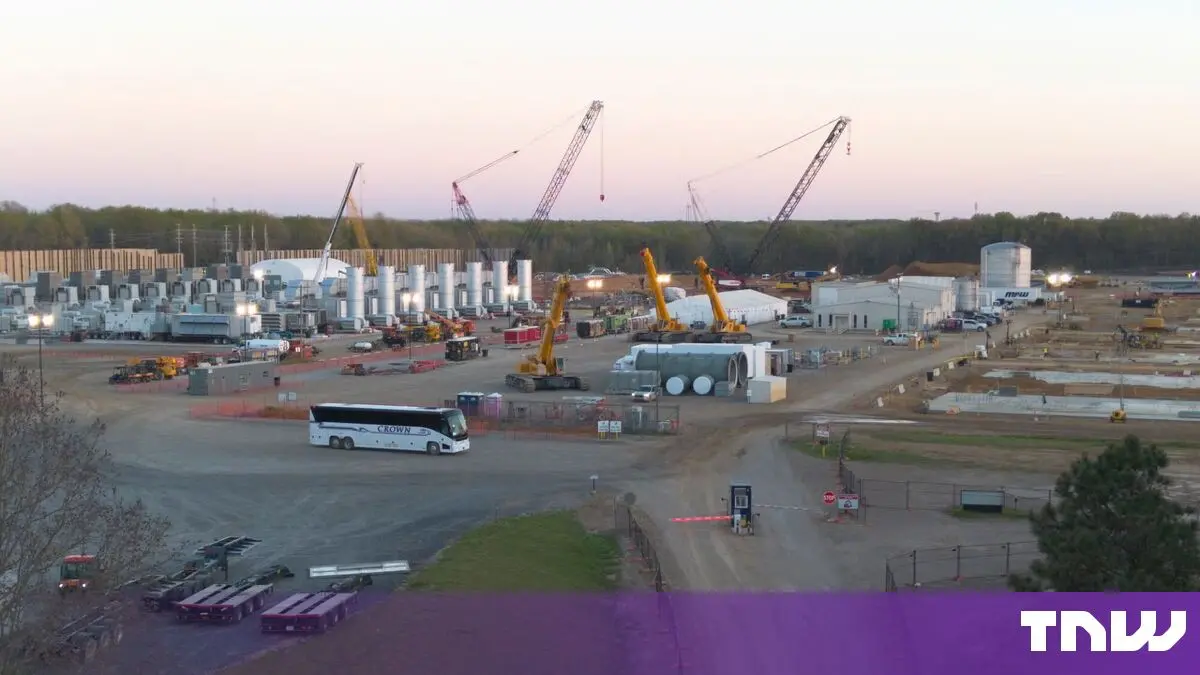
A federal judge in Mississippi has refused to throw out a Clean Air Act lawsuit brought by the NAACP against xAI over the gas turbines that supply power to the company's Colossus 2 data centre, handing the artificial intelligence developer an early procedural defeat in a case that has become a test of how the industry's runaway electricity demand is regulated.
Judge Debra M. Brown ruled on Friday that the turbines at the Southaven, Mississippi plant are not exempt from air permitting as "mobile sources," rejecting the central legal theory the company has relied on to argue the equipment can operate without the kind of permits normally required of stationary power plants. The same opinion also dismissed xAI's argument that lawsuits brought by citizen groups under the Clean Air Act are unconstitutional.
"Because citizen suit plaintiffs sue on their own behalf, in their own name, and seek penalties that redress harm to themselves, they are not exercising the federal government's executive power," Judge Brown wrote in her opinion.
The ruling keeps alive a case that has drawn attention well beyond Mississippi, because it sits at the intersection of two fast-moving trends: the scramble by AI companies to secure enormous quantities of electricity, and the willingness of community and civil rights groups to use federal environmental law to challenge the infrastructure that supplies it.
What the NAACP alleges
The NAACP and its Mississippi State Conference sued xAI and its subsidiary MZX Tech in April. According to the complaint, the companies installed gas turbines at the Southaven plant between August and December 2025 without obtaining the air permits the law requires. By April, the complaint says, there were at least 27 turbines on the site, with a combined generating capacity of at least 495 megawatts.
The lawsuit estimates that the turbines could emit roughly 1,700 tons of nitrogen oxides a year. Nitrogen oxides are a principal precursor to ground-level ozone, the main ingredient in smog, and are linked to respiratory problems, aggravated asthma and other health effects, particularly in children and older adults. The NAACP is asking a court to order pollution controls on the equipment and is seeking civil penalties of up to $124,426 a day for each violation.
The plant sits just across the state line from Memphis, Tennessee, where the Colossus 2 facility operates. That geography matters: the turbines are sited in Mississippi, but the airshed they affect is shared with a large metropolitan area, and the emissions do not stop at a state border.
xAI's defence
The company's position has rested heavily on guidance it received from Mississippi's environmental regulator. In July 2025, the state agency told xAI that the turbines would be exempt from permitting, describing them as mobile because each unit sits on a trailer, and as temporary because each would remain on site for less than 12 months.
Those two concepts — the mobile source exemption and the temporary source exemption — are long-established features of federal and state air permitting programs, designed originally for equipment such as portable generators, compressors and construction machinery that moves from site to site rather than operating permanently at a single location. xAI argued that it had relied on the regulator's interpretation in proceeding with the installation.
Judge Brown found that the regulator had "fairly notified" xAI of its position, but she held that the court was not bound by that view. Under the federal rules that Mississippi's state implementation plan adopts, she wrote, the Southaven plant is not a mobile source. The practical consequence is significant: if the turbines are treated as a stationary source, they fall within a permitting regime that requires pre-construction review, emissions limits and, potentially, the installation of pollution controls.
The company has not commented publicly on the ruling.
The Justice Department's attempt to end the case
The litigation has also produced an unusual constitutional confrontation. The US Justice Department backed xAI's position in June and then asked the court to dismiss the case outright. On 19 October, the same court ruled against the department, according to the Southern Environmental Law Center, which represents the NAACP alongside Earthjustice.
The court allowed the department to join the case but refused to let it terminate the litigation. That outcome is notable because citizen suits under the Clean Air Act are expressly designed to let private parties enforce environmental standards when regulators decline to act. A federal agency intervening on the side of a defendant to shut such a suit down raises questions about the separation of powers that Judge Brown addressed directly in her opinion on Friday.
The court has yet to rule on the NAACP's request for a preliminary injunction, which could determine whether the turbines are allowed to keep operating, or must be retrofitted or curtailed, while the case proceeds.
Why the case matters beyond Mississippi
The dispute is one of the first significant legal tests of a model that is spreading quickly across the United States: AI developers building dedicated, on-site generation rather than waiting years for grid interconnection and new utility-scale plants. Data centre operators have increasingly turned to gas-fired turbines — often trailer-mounted aeroderivative units originally marketed for temporary or backup duty — to bridge the gap between their power needs and what local grids can supply.
That approach is fast, but it collides with a permitting system built on the assumption that large stationary sources will be reviewed before construction. If operators can characterise a bank of turbines as mobile or temporary equipment, they can compress timelines dramatically. Environmental groups argue that outcome effectively lets the largest new source of emissions in a region escape review entirely, and that the exemptions were never intended to cover configurations of dozens of units operating continuously for months or years.
The broader context is a nationwide surge in electricity demand driven by data centres, which has pushed utilities to delay the retirement of fossil plants and prompted developers to pursue behind-the-meter generation. Memphis and its surroundings have seen some of the most intense activity, with the Colossus facilities among the largest single concentrations of computing capacity in the country.
Air quality in the Memphis area has long been a concern for regulators and community groups, particularly during summer ozone season, and the addition of hundreds of megawatts of uncontrolled combustion turbines nearby has amplified those worries. The NAACP's complaint frames the issue in civil rights terms as well as environmental ones, arguing that the burden of additional pollution falls disproportionately on majority-Black communities near the site.
Community pressure and political fallout
The lawsuit is not the only front. Residents living near the plant have filed a noise class action, complaining about industrial sound from the turbines. xAI has offered to buy nearby homes from owners who agree to drop their claims — an approach that critics describe as an attempt to dissolve opposition property by property, and that the company has not detailed publicly.
The political environment is shifting as well. On Tuesday, voters in 10 US states will decide on ballot measures intended to limit data centre development, reflecting growing local resistance to the power, water and land demands of the AI build-out. Those votes will not affect the Mississippi litigation directly, but they signal that the permitting questions at stake in the courtroom are now central to a wider public debate.
The NAACP's director of environmental and climate justice, Abre' Conner, said in a statement: "The courts have repeatedly rejected attempts by xAI and the DOJ to dismiss the NAACP's Clean Air Act case."
With the motion to dismiss denied, the case proceeds to the preliminary injunction stage, where the court will weigh the NAACP's evidence of harm from the turbines' emissions against the company's interest in continuing to power one of the largest AI computing clusters in the world.
Source: TNW | Xai News