

The global shift toward renewable energy has led to a rapid increase in wind farm installations. But as turbines age and are decommissioned, a new environmental challenge emerges: how to handle the massive waste. While wind turbines continue to improve in efficiency and power generation, recycling them has been more challenging. With the amount of waste expected to rise significantly in the coming decades, innovative solutions are urgently needed.
In 2025, New York's first wind farm was torn down, with some of its components potentially ending up in a landfill. This scenario is likely to become more common as the first generation of turbines reaches the end of their operational life. Fortunately, creative engineers and designers are finding new purposes for these retired machines, offering a glimpse of a more sustainable future.
Turbine Nacelles Transformed into Tiny Homes
Perhaps the most surprising reuse comes from the nacelle—the large housing at the top of the turbine that contains the generator, gearbox, and other critical components. Once a turbine is decommissioned, the nacelle can be repurposed as a tiny home. The project, called 'The Nestle Tiny House,' is the first of its kind, developed by Superuse Studios in collaboration with a European energy company. The 376-square-foot structure includes a kitchen, bathroom with functional plumbing, and a living room that doubles as a bedroom when the sitting furniture is folded out. It also features heating and a water heater powered by solar panels on the roof.
According to a key member of the design team, everything in the built environment has an end of life, and we need solutions beyond waste, landfill, or incineration. This project demonstrates that even the most industrial components can be given a second, attractive life. As more turbines retire, such tiny homes could become a viable option for affordable housing, especially in rural or off-grid areas.
The Blade Recycling Problem
While the nacelle can be repurposed, the blades remain a significant recycling challenge. Wind turbine blades are typically made of fiberglass-reinforced polymer or carbon fiber composites. These materials are extremely strong and durable, but they are notoriously difficult to recycle. Unlike most plastics, they cannot be melted down and reformed because they consist of a thermoset polymer. As an expert in chemistry explained, the material is essentially one giant molecule, with every atom connected through a 3D network. This molecular structure makes it impossible to heat the blades into a liquid for repurposing.
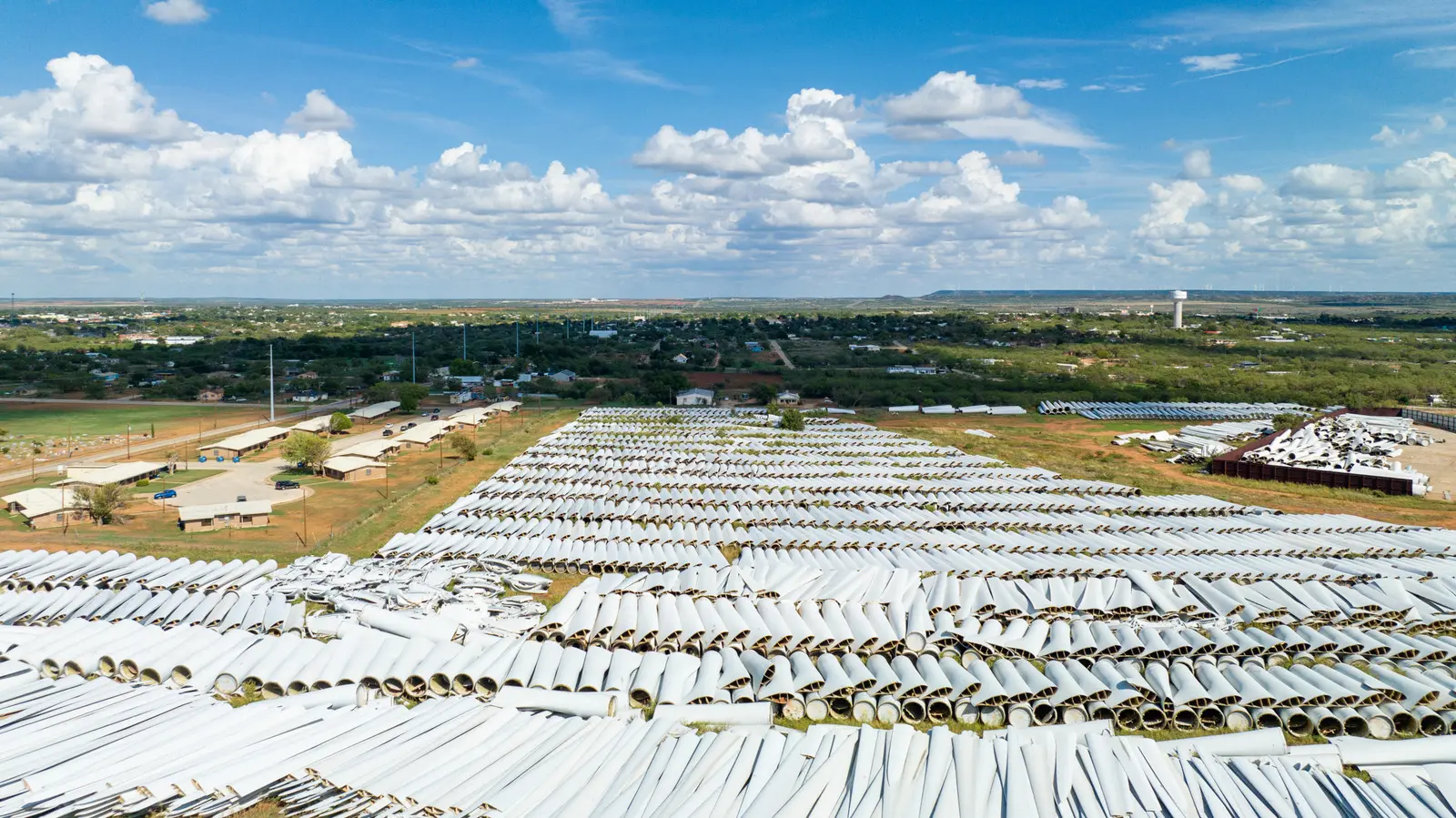
Without a straightforward recycling method, decommissioned blades often end up in large heaps, such as one found in Sweetwater, Texas. In 2023, that small town was dealing with a thirty-acre area covered in stacks of blades several feet high. This is not an isolated case; as the wind industry expands, the problem is expected to grow. By 2050, the world could have more than 40 million tons of blade waste, and currently, only a small fraction is recycled.
Innovations in Blade Recycling
Fortunately, research institutions and companies are developing new ways to tackle the blade waste problem. Researchers at the University of Tennessee, in collaboration with Carbon Rivers, have created a method to break down the stout fiberglass from decommissioned blades so it can be reused to make new blades. This process involves chemical recycling that separates the fibers from the resin, allowing the materials to be reintroduced into the manufacturing supply chain.
Additionally, other companies are exploring the use of crushed blade material as a filler in cement production, which could reduce the carbon footprint of concrete. Some blades have been repurposed as bridges for pedestrians and cyclists in Denmark, while others have been turned into bus shelters, bike racks, and even playground equipment. These creative solutions not only keep waste out of landfills but also showcase the versatility of the materials.
Another promising development is the news of a self-repairing material that could allow cars, planes, and wind turbines to last for hundreds of years. If this technology becomes commercially viable, it could drastically reduce the amount of waste generated by the wind industry. However, for now, the focus remains on improving the recyclability of existing blades.
Global Impact and Future Outlook
The growth of wind energy is essential for combating climate change, but it must be accompanied by responsible end-of-life management. The International Energy Agency estimates that global wind capacity could triple by 2030, leading to a proportional increase in future waste. Governments and industry bodies are beginning to address this issue; the European Union has introduced legislation requiring that turbine blades be recyclable by 2025. In the United States, the Department of Energy is funding research into advanced recycling technologies.
Some manufacturers are also redesigning blades to be more recyclable from the start. For example, one major wind turbine maker has developed a recyclable blade made from a thermoplastic resin that can be melted down and reused. Others are looking at using natural fibers or modular designs that make disassembly easier.
The tiny home project is just one example of how circular thinking can turn a waste problem into an opportunity. As more turbines are decommissioned, we can expect to see even more surprising uses for retired components. From homes to bridges to playgrounds, old wind turbines are proving that their life does not have to end at the landfill.
The key to a sustainable future lies not only in generating clean energy but also in managing the resources used to produce it. With continued innovation and investment, the wind industry can lead the way in both energy production and waste reduction.
Source: SlashGear News